
How to Get 30 Minutes Back After Every Meeting
Here’s the fastest way to close the meeting for real

You're in a client meeting. Important one. The kind where details matter.
You're trying to listen. Really listen. But you're also frantically typing notes because if you don't capture this now, you'll forget the crucial detail that makes or breaks the follow-up.
So you're half-listening, half-typing, and fully stressed.
By the end of the meeting, you have pages of notes. But here's the uncomfortable truth: you missed things. Important things. Because you can't fully engage in a conversation whilst simultaneously documenting it.
This scene plays out thousands of times daily across organisations. And most teams treat it as normal.
You know what? It's not. It's value leaking from every meeting you run
The Real Cost of Manual Note-Taking

Let's talk numbers for a moment.
The transcription industry standard is four hours of work for every one hour of clear audio. That's a 4:1 ratio. If you attend a one-hour meeting, creating accurate notes traditionally takes four hours of focused transcription work.
Most people don't spend four hours on their meeting notes. They spend maybe 20 minutes cleaning up what they scribbled during the call.
The result? Notes that capture 30% of what was actually discussed, with accuracy that depends entirely on how fast you type and how well you multitask.
Now multiply that across every meeting in your week. Client calls. Team standups. Strategy sessions. Performance reviews.
How much are you actually capturing? How much are you missing?
What Actually Happens in Meetings

Here's the pattern I've observed across hundreds of client meetings:
Minutes 0-10: You're engaged, alert, taking decent notes. You capture the main points.
Minutes 10-30: Your typing speed can't keep up with the conversation. You start summarising in your head, losing specifics. Someone makes an excellent point whilst you're still typing the previous one. You miss it.
Minutes 30-45: Fatigue sets in. Your notes become bullet points. "Follow up on Q3 numbers." What Q3 numbers? What context? Future you will have no idea.
Minutes 45-60: You've mostly given up on comprehensive notes. You're just trying to stay present in the conversation whilst occasionally jotting down things that seem important.
After the meeting: You spend 20 minutes trying to reconstruct what happened from your fragmented notes. You email colleagues asking "What did the client say about the timeline?" You wish you'd captured more.
This isn't a personal failing. It's a human limitation.
We cannot simultaneously engage fully in conversation and document it comprehensively. These are competing cognitive tasks.
The Multilingual Problem Gets Worse

Now add language barriers to this equation.
You're in a meeting with international clients or team members. They're speaking English, but it's not their first language. You're catching most of it, but occasional phrases get lost. Cultural references don't quite land. Technical terms get mangled in translation.
You're now doing three things at once: listening, translating mentally, and taking notes. Something has to give. Usually, it's comprehension.
Or perhaps you're the non-native English speaker. You understand the conversation, but taking notes in real-time in a second language whilst processing complex information? Nearly impossible.
Research shows that language barriers significantly impact meeting effectiveness, with participants spending mental energy on language processing rather than content engagement.
The result is meetings where everyone leaves with different understandings of what was decided.
What If You Could Just Listen?

Imagine walking into a meeting with one job: listen and engage.
No frantic typing. No splitting your attention between conversation and documentation. No anxiety about missing crucial details.
You're present. You're asking better questions because you're not worried about capturing the answers. You're noticing tone, body language, and subtext that you'd miss whilst staring at your keyboard.
The meeting ends. You have a complete transcript of everything discussed. An accurate summary of key points. Action items clearly listed. All without having typed a single word.
This isn't theoretical. It's how meetings should work.
How Real-Time Meeting Transcription Works
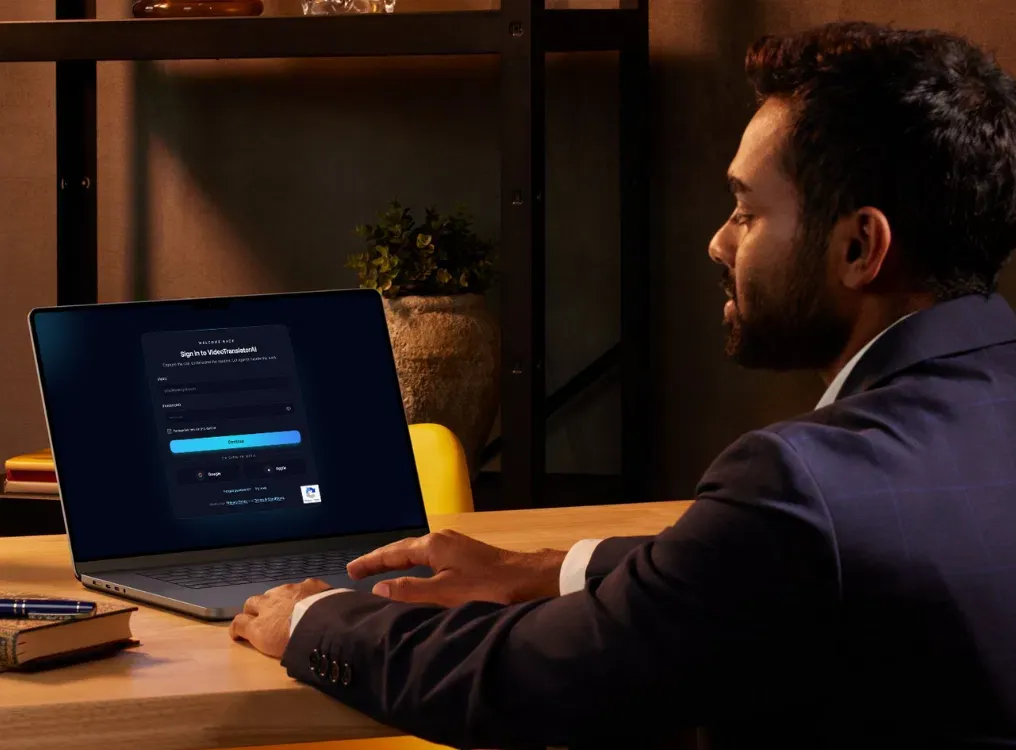
The technology is simpler than you'd expect.
Before your meeting starts, you make three quick decisions:
Step 1: Choose your output

Do you need a transcript or a translation? Select your option. If you're working across languages, choose which language you need the output in.
Step 2: Select your language

Pick the primary language of your meeting. The system handles the rest, including multiple speakers and accents.
Step 3: Customise your summary

This is where it gets interesting. You're not limited to generic summaries. Tell the system what matters to you:
"Focus on action items and deadlines"
"Capture technical specifications and requirements"
"Summarise client concerns and objections"
"List all numbers, dates, and commitments mentioned"
The AI will structure the summary around what you actually need, not what a generic algorithm thinks is important.
Step 4: Click start

That's it. Your meeting begins. You engage naturally. The system captures everything in real-time.
After the meeting ends

Download the full transcript, get the customised summary, or send everything to your email for later review.
The entire process from "meeting starts" to "summary in your inbox" happens without you touching a keyboard.
Calculating the Recovered Value

Let's put numbers to this shift.
Traditional workflow for a 30-minute multilingual meeting:
Meeting duration: 30 minutes
Transcription wait time: 2 to 4 hours (often next day)
Human review and cleanup: 45 minutes
Translation for non-English speakers: 1 to 2 hours
Summary creation: 30 minutes
Total time cost: 5 to 7 hours per meeting
With real-time processing:
Meeting duration: 30 minutes (with live translation)
Summary generation: 15 seconds
Review and distribution: 10 minutes
Total time cost: Under 45 minutes
That's not a percentage improvement. That's an order of magnitude difference.
When This Matters Most

Real-time meeting transcription shines in various scenarios:
Client meetings: When details matter and relationships are on the line, being fully present whilst capturing every commitment makes the difference between successful partnerships and missed expectations.
Cross-functional collaboration: When engineers talk to designers talk to marketers, terminology gets confused and context gets lost. Complete transcripts help teams align on what was actually decided.
International teams: Language barriers create information loss. Real-time translation and transcription ensure nothing important disappears in translation.
Performance discussions: When conversations have legal or HR implications, accurate documentation protects everyone involved whilst allowing the discussion to flow naturally.
Technical requirements gathering: When specifications matter and misunderstandings are costly, capturing exact requirements prevents expensive mistakes down the road.
Board meetings and governance: When decisions need documentation for compliance or legal purposes, automated transcription ensures completeness without disrupting the meeting flow.
If your work involves regular important meetings, the question isn't whether you need better tools. It's how much longer you can afford to wait.
What You're Actually Trading
When you adopt real-time meeting transcription, you're not trading money for convenience.
You're trading incomplete, attention-divided documentation for complete, engaged participation.
You're trading "I think they said something about Q3" for "here's exactly what they said about Q3, with context, at timestamp 23:47."
You're trading post-meeting reconstruction from fragmented notes for immediate access to complete, accurate records.
You're trading cognitive overload for presence.
It's time to stop pretending you can do both and start using tools that let you do what actually matters: engage fully, listen deeply, and respond thoughtfully.
The documentation will take care of itself.
The first time you finish a call and receive a complete summary before you've even closed the window, you'll understand why teams are moving away from traditional transcription workflows.
*Ready to stop splitting your attention in meetings? Our tool transcribes, translates, and summarises your conversations in real-time, so you can be fully present whilst capturing everything that matters. Simple setup. Customisable summaries. Complete documentation without the cognitive juggling act.