
Your Support Team Speaks English. Half Your Customers Don't.
How language kills trust in global support

The support ticket was simple. A billing discrepancy is easy to fix.
But the customer spoke Japanese, and the agent spoke English, and somewhere between the two, the conversation collapsed.
No resolution. No callback. Just a public complaint and a churned account.
Language didn’t kill the relationship. The absence of a plan for language did.
Language Barriers Erode Customer Trust

Customer service is fundamentally about one thing: making people feel understood.
Language shapes that entirely. When customers can’t articulate what’s wrong, they feel invisible.
When agents misread the situation, they confidently solve the wrong problem.
Small miscommunications carry outsized consequences in fintech, travel, ecommerce, and education.
A misunderstood instruction can block an account. A misheard address ships a parcel to the wrong country. An unclear complaint never reaches the right team.
Where Language Breaks Down

The pattern looks different depending on the industry, but the outcome is the same.
Let’s think about the following scenarios:
In fintech, a Korean customer tries to unfreeze a flagged transaction. They can’t explain the context in English clearly enough. The account stays frozen. At the end, they decide to switch banks. That’s not a fraud prevention win. That’s a churn event caused by a communication gap.
In travel, a Spanish-speaking family’s flight gets cancelled. The rebooking options are explained in fast, jargon-heavy English. They miss the window, miss the connection, and lodge a complaint that ends up on social media. In this era, we all know that a simple complaint on social media can burn your brand to the ground.
In e-commerce, a customer in Vietnam orders the wrong variant because the return policy wasn’t understood. The agent closes the ticket. The customer files a chargeback.
In education, an international student can’t follow the enrolment instructions delivered in English. They miss a deadline. They defer. Sometimes they don’t come back.
Each of these is a solvable problem. None of them needed to happen.
Most companies push the problem onto the customer.
“Use English.” “Try our FAQ.” “Submit a ticket.” None of that is support. It’s deflection.
After the Call Is Where Things Really Break Down

There’s a part of the language problem that rarely gets discussed.
The call ends. What happens next?
An agent’s memory of a fast, multilingual conversation is patchy at best. Notes are rushed. Action items get dropped. The customer rings back, explains everything again, and trusts you a little less than they did before.
The second call costs twice as much as fixing the first one properly.
Why Hiring Your Way Out of This Doesn’t Scale
The obvious counter-argument is: just hire bilingual agents.
It sounds sensible until you do the maths. A bilingual agent in a major market costs significantly more to recruit, train, and retain. And they only solve one language pair. Your Spanish-speaking hire doesn’t help when a customer calls in Tamil, or Tagalog, or Hungarian.
There are over 7,000 languages in the world. Even narrowing to the top 50 by global speaker count, no support team can hire their way to full coverage.
And that’s before you factor in time zones, shift patterns, and the availability of qualified bilingual candidates in niche language combinations.
Hiring is a partial solution that works at small scale, in a small number of markets, for a small number of languages. It doesn’t hold as you grow.
The smarter path is infrastructure. Build the capability into the platform, not the headcount.
What Solving This Actually Looks Like
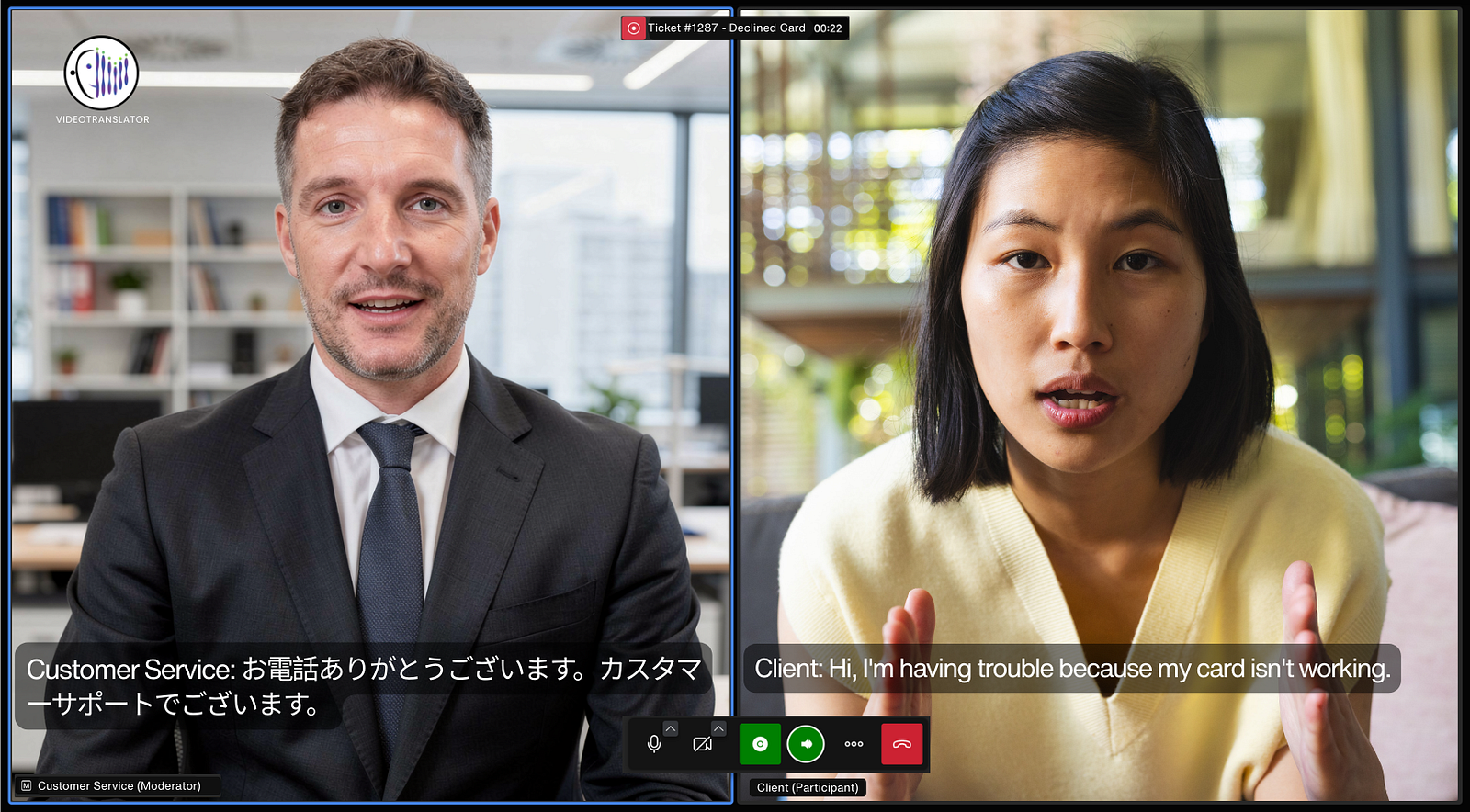
VideoTranslatorAI handles live video calls between customers and agents who speak different languages.
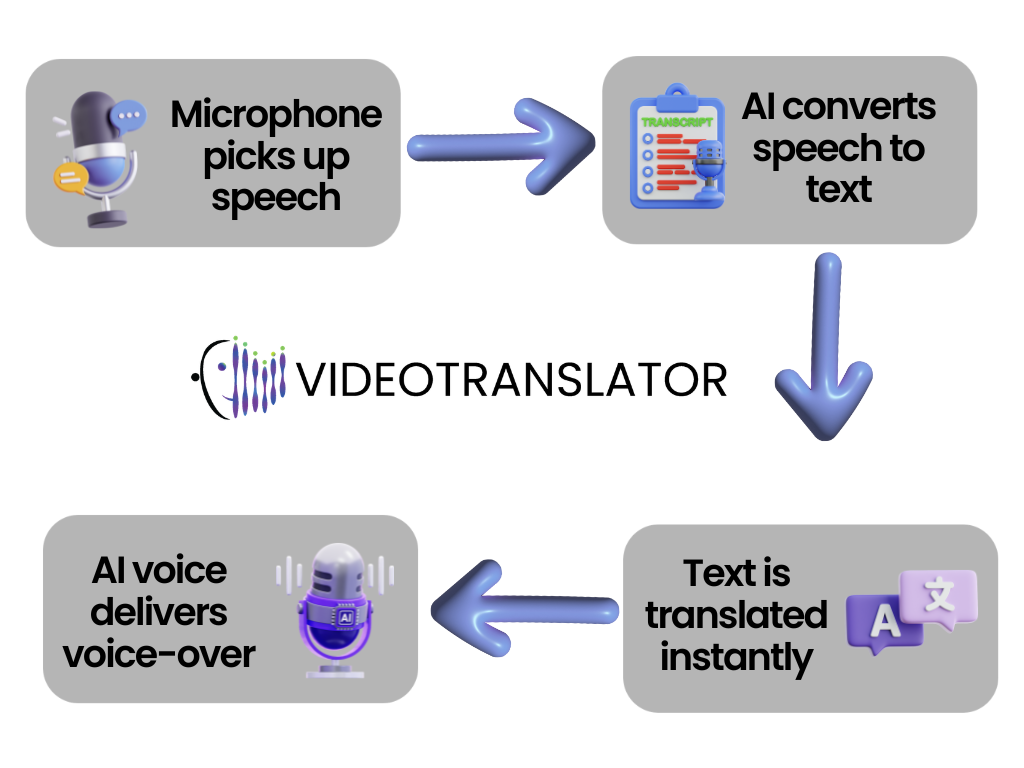
Both sides speak naturally in their own language. The platform transcribes and interprets speech in real time, delivering subtitles and voice-over simultaneously so neither party misses a word.
There’s no pause-and-wait, no awkward silence while a translation loads. The conversation flows.
When the call wraps up, the platform generates an AI summary of what was discussed, what was resolved, and what needs follow-up. Agents have a clean record. Customers get clarity. Nothing falls through the gaps.
It runs the same experience from São Paulo to Seoul to Stockholm.
What This Does for Your Agents
Language management is exhausting work that agents were never trained for. When you remove that load, focus returns to what they’re actually good at: listening, problem-solving, and creating positive outcomes.
Cases close faster. Fewer calls escalate. Teams operate confidently across time zones without language anxiety eating into performance.
The platform currently supports 55 languages, including Arabic, Hindi, Spanish, Korean, and Japanese. Language coverage expands in line with where customers are.
The Standard Has Already Changed

Customers no longer benchmark your service against your direct competitors. They benchmark it against every great service experience they’ve ever had, across every industry, in every language.
Global support used to mean a multilingual FAQ. That’s not enough any more.
Every customer deserves a conversation, not a workaround. The tools exist. The only question is whether your business uses them.
Handling international inquiries can be tricky, but it doesn’t have to be. If you’d like to see how VideoTranslatorAI can help your team bridge the language gap instantly, feel free to click here and try it for free.