
He’s 17, Runs a Startup, and Designs His Own Curriculum
What AI education looks like when students lead

We have been telling the negative story about AI and education a lot.
Pick up any newspaper, open any parent forum, and you will find the same anxiety playing out in a loop:
AI gives students instant answers, students stop thinking, students become intellectually dependent and academically dishonest.
The villain is clear. The verdict is in. AI is making the next generation dumber.
I have heard that story so many times that I almost started believing it myself.
Then I came across a piece by the team at Every, where Dan Shipper sat down with Alex Mathew, a 17-year-old high school senior in Austin, Texas. What followed was one of the most optimistic conversations about the future of education I have encountered in a long time.
I felt a genuine urge to amplify it, because it deserves a wider audience than it may otherwise reach.
A School That Turned The Classroom Inside Out
Mathew attends Alpha High School, part of a rapidly expanding network of kindergarten-through-grade-12 private schools that have made a radical decision: no traditional teachers.
Academic content is delivered entirely through an AI-powered learning platform called Timeback. The adults in the room, known as “guides,” do not teach curriculum. Their job is to support students emotionally and keep them motivated.
The school day begins at 8:30 a.m. with what Mathew describes as “Tony Robbins for kids.” Before any academic work starts, students spend 15 minutes shifting from “home mode” to “school mode.”
They might debate an LLM, solve a puzzle, or discuss something interesting they found on X. Students are grouped into “houses,” Hogwarts-style, based on personality and the progress they have made on their individual projects.
Then comes the academic block: two to three hours of focused learning, structured into 27-minute intervals with five-minute breaks. Timeback delivers a personalised stream of videos, articles, and quizzes, some built by Alpha, others sourced from third-party providers. AI runs quietly in the background, customising what each student sees and tracking where their understanding has gaps.
And crucially, there is no AI chatbot tutoring anyone. Alpha tested that approach but it did not work.
When students had open access to a chatbot, they used it to cut corners. When the chatbot was restricted, it became useless. So the school moved on.
The AI serves the learning architecture. It does not replace the student’s thinking.
Motivation is The Real Curriculum
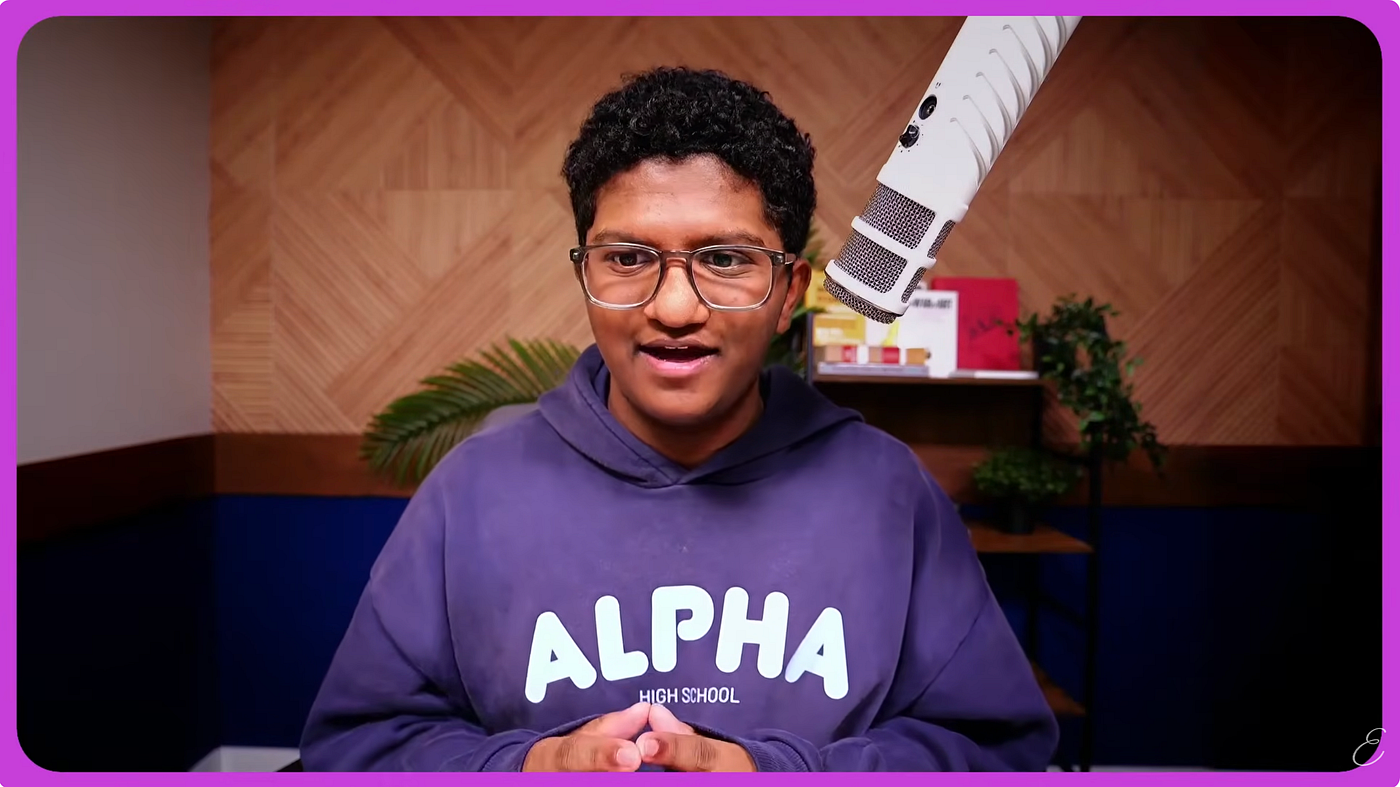
Here is the insight from Mathew that has stuck with me: “It is 90 percent motivation, 10 percent education technology.”
That ratio matters. The school does not rely on AI to do the heavy lifting. It relies on genuinely motivated students. The AI is the infrastructure. The drive to learn still has to come from somewhere human.
Alpha builds that motivation in several ways. For subjects a student loves, the content itself is the reward.
Mathew breezes through AP Psychology because it connects directly to his startup, a company called Berry that he is building around an AI-stuffed animal designed to help teenagers manage their mental health.
For subjects students dislike, the school gets inventive, offering students money toward their projects or invitations to social outings, called “FOMOs,” when they hit their targets.
The school also gives students something most educational institutions never offer: genuine agency. Mathew negotiated with his guides to complete his first semester early so he could fly to San Francisco and work on Berry full-time, then return to finish his second semester without losing credits.
That is not a loophole. That is the design.
The Barrier that Motivation Alone Cannot Solve
Reading about Alpha High School, I kept thinking about a different kind of barrier: not the absence of motivation, but the absence of access.
I recall coming across Nippon.com’s article last year about the growing need for specialised Japanese language instruction in Japan. As of the fiscal year 2023, nearly 70,000 students in elementary, junior high, and high schools required this support, a number that has more than doubled over the past decade.
Interestingly, in 70 percent of the schools where these students are enrolled, there are only four or fewer students needing such instruction. This small ratio makes it challenging for local governments to justify dedicating specialised staff to address the issue effectively.
In fiscal 2023, 970 school-age foreign children were confirmed not to be attending school at all. That represents a 24.6 percent increase over the previous year.
Taking into account children whose attendance status was unclear, the number of young people potentially excluded from education entirely may reach 8,601.
These are not students lacking motivation. They are students locked out of a learning environment because it operates in a language they cannot yet follow.
The AI-enhanced classroom that Alex describes at Alpha High could not help them if the lesson itself is inaccessible.
That is the gap VideoTranslatorAI was built to close
Real-time Translation, Built for Education
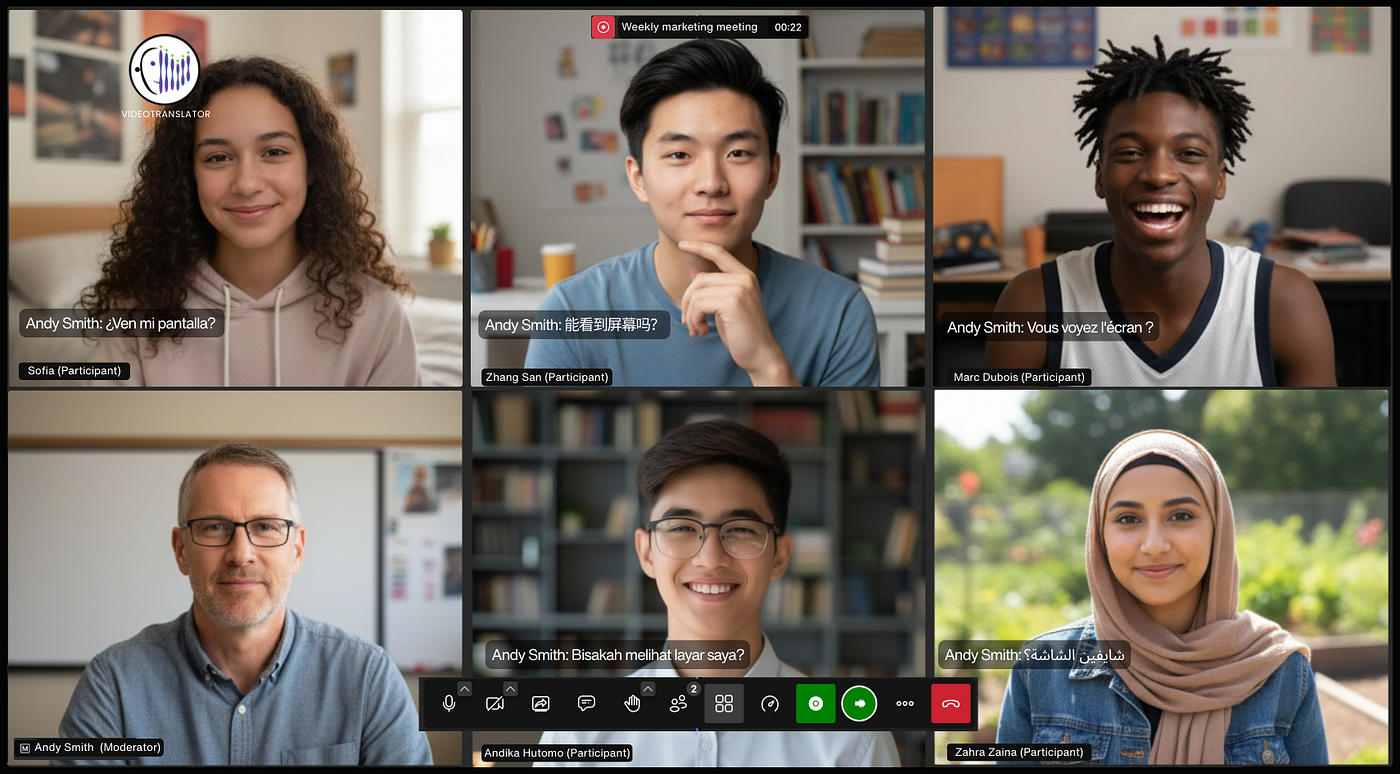
Our multilingual video call platform allows students and teachers to speak in their own language during live sessions. AI handles real-time translation for every participant simultaneously.
Every person in the session receives subtitles in their chosen language as the lesson progresses. A natural voice-over translation also runs in parallel, which participants can activate or mute depending on how they prefer to learn.
In practice, this means a teacher conducting a session in English can be understood in real time by a student following along in Portuguese, another in Vietnamese, and a third who has switched on German voice-over.
No lag. No parallel tracks. No student sitting in silence because the content moved faster than their ability to translate.
The platform extends to multilingual broadcasting for larger events: universities, global training programmes, and educational conferences. A single session streams to hundreds of participants, each receiving live subtitles and voice-over in the language of their choice. The institution runs the session once. The translation happens automatically.
The connection to what Alpha High School has built is not just thematic. Both approaches rest on the same conviction: friction is the enemy of learning.
At Alpha, the friction is a rigid structure that does not adapt to individual students. In the classrooms VideoTranslatorAI serves, the friction is language.
Remove the friction, and students can finally get to the actual work of thinking, growing, and making sense of the world.
Why This Story Deserves A Wider Audience
I am grateful to Dan Shipper and the Every team for the episode that sparked this piece. What they offered was something rare: a conversation about AI and education conducted with the people actually inside it, rather than the people theorising about it from a distance.
Alex Mathew is building a startup at 17. He is thinking carefully about the tradeoffs in his generation’s relationship with technology. He is navigating his own education with more intentionality than most adults bring to their careers. And he is doing it at a school that trusted him enough to let him design his own path through it.
That is the story worth repeating. Not because AI is a panacea. Not because every school should look like Alpha. But because when technology is designed around what students actually need, rather than what is administratively convenient, genuinely remarkable things become possible.
At VideoTranslatorAI, we are trying to do the same thing for language. Because the student who cannot follow the lesson should never be written off as uninterested.
They may simply have never had the chance to understand what was being said.
This piece was inspired by the AI & I podcast episode “Inside an AI High School, Through the Eyes of a 17-Year-Old Founder,” produced by Dan Shipper and the Every team. It features a conversation with Alex Mathew, a student at Alpha High School in Austin, Texas. The full episode is available at every.to
Highly recommended listening!