
Not Everything Made with AI is Slop
So, what does AI Slop actually mean?

Merriam-Webster named “slop” its word of the year for 2025. The American Dialect Society followed with the same verdict in January 2026, with over 300 linguists voting it in.
That is a rare double crown for a term that barely existed in common usage two years ago.
The definition Merriam-Webster settled on is this: “digital content of low quality that is produced usually in quantity by means of artificial intelligence.”
It is a reasonable starting point. But in practice, the word that was meant to name a failure of quality and intent has become a shorthand for a failure of legitimacy, which is a completely different, more troubling claim.
This is worth unpacking carefully. Underneath the culture war, there is a real concept trying to survive, and it is more useful than the version we have been handed.
The Drift From Descriptor to Slur
Somewhere in the past twelve months, “AI slop” stopped being a description of a specific quality failure and started functioning as a general-purpose insult for anything AI-generated.
You can see this in the comments under AI-assisted articles, in posts about AI images, and in discussions about software built with coding agents.
Someone shares a piece of AI-assisted work they are proud of. Someone else types “slop” in the comments. The word doesn’t mean anything precise in that context. It means: I do not respect that you used AI.
But why did the massive hatred happen in the first place?
It’s all because generative AI brought not just new tools but a complete restructuring of the production cost of content. When the cost of generating a large volume of images, articles, or videos approaches zero, platforms built for engagement are flooded with content that exists purely to be published.
No consideration of the reader, the viewer, or the listener. No editorial judgment. Just output. “Slop” named that flood.
However, the same word now applies to a well-crafted article drafted with AI assistance and carefully edited, to a photograph where AI was used to clean up noise, or to an app where AI wrote the boilerplate code and a human designed the product.
Today, any use of AI has become suspect, then guilty.
That expansion made the word less true, not more emphatic.
Objective Criteria: What Actually Qualifies as Slop
If we are going to use “slop” as a meaningful term rather than a mood, it needs observable criteria.
These are mine, tested against a wide range of examples.
1. Absence of Intention
This is the core criterion. Everything else follows from it.
Slop was not made for anyone in particular, to do anything in particular. No creative decision was genuinely made. No one asked: who is this for, what do I want it to do, and does it actually do that?
The practical test: can the person who made it tell you specifically who benefits and how? Not in abstract terms (“content creators” or “people who need X”) but with real specificity: a person, a friction, an outcome. If the answer is genuinely empty, intention is absent.
Note that intention cannot be inferred from the tool used. A batch-generated AI image with no human decision in the loop has no intention. A carefully developed AI-assisted piece, where the creator made real choices at every stage, does.
The tool is not the evidence. The decision is.
Now, seriously, can anyone tell me what’s the goal of this video?
2. Bad Quality
Slop is technically poor in a way that indicates nobody cared.
There is an important distinction here. Work that is rough because resources were limited is not slop, provided someone tried. Work that is incoherent, factually wrong, visually broken, or internally contradictory, and nobody responsible checked or cared, is.
For visual content: anatomically broken figures, compositions that communicate nothing, lighting that contradicts itself, on-image text that degrades into artifacts. Not failures of budget or skill, but failures of attention. The output was not examined because examination was not the point.
“Bad quality” in this context means: someone could have caught this, with any effort, and no effort was applied.
3. Algorithm Exploitation
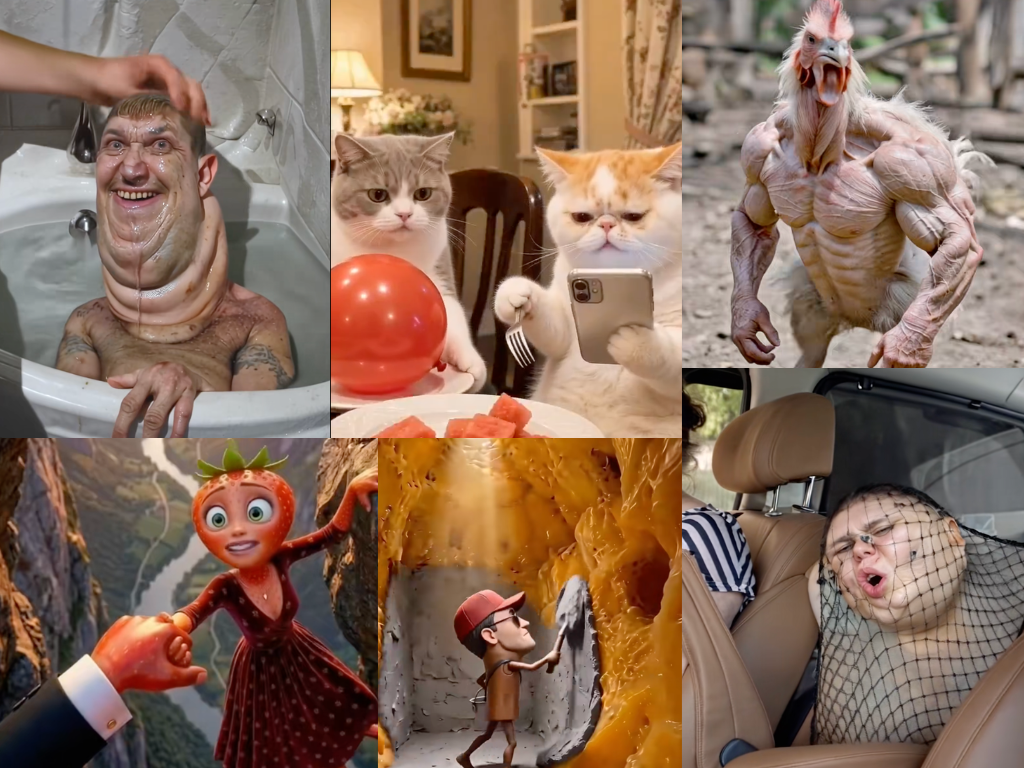
Slop is engineered for a platform metric, not for a human being.
The audience exists in name only. The actual objective is: clicks, watch time, shares, saves, or search rankings. Every design decision in the content serves that extraction goal. The person who encounters it is a mechanism for producing the metric, not a person to be served.
Evidence of this: content withholding its actual value to force engagement, hooks that set up nothing, videos that exist entirely to capture an opening-minute watch event, and articles padded with search terms that do not improve the argument. The structuring logic is the platform’s recommendation system, not the reader’s needs.
Together, these three criteria describe a content object that was made without a real reason, produced without real care, and distributed to extract rather than provide value. That is slop.
And note: none of the three criteria requires AI to be present.
App Slop: A Different Kind of Problem
Here is where things get more complicated, and where the existing conversation has a genuine gap.
The “AI slop” conversation was born in visual content. Blurry images, cookie-cutter videos, AI-voiced YouTube channels recycling public domain facts. The three criteria above fit that world reasonably well.
But there is a parallel epidemic happening in software, and it doesn’t fit neatly into the same frame.
App slop is the wave of products built in the AI era that look like tools but function like theatre.
You have seen them. An AI wrapper with a landing page full of gradient blobs and a pricing table, solving a problem nobody actually had. A “productivity suite” that is three API calls dressed up in Framer. A B2B SaaS with seventeen features in the screenshot and two that actually work in production.
The visual-content criteria need translation here.
Absence of intention becomes absence of genuine problem-solving intent. The app was built to capture a market position, attract investment, or ride a trend, rather than because someone identified a real friction and decided to fix it. The founders can recite the TAM. They cannot tell you one specific person the product meaningfully helped.
Bad quality becomes unreliable, shallow, or fundamentally broken functionality dressed up in polished UI. App slop often looks better than it works. The Figma mockup was immaculate. The actual product crashes on Android, loses data silently, or delivers AI outputs so generic they are useless. Quality in software means: does it reliably do the thing it claims to do, for real users, in real conditions?
Algorithm exploitation becomes App Store optimisation, paid acquisition for metrics that do not reflect real value, fake reviews, viral loop engineering designed to inflate user numbers rather than user outcomes. The app’s goal is to hit a number (downloads, MRR, DAUs) that impresses someone externally, not to generate genuine utility internally.
There is one extra dimension in software that doesn’t apply to images: extractive design. App slop often turns users into the product through dark patterns, compulsive engagement loops, or data harvesting that far exceeds any value the user receives in return. You are not a user of app slop. You are the raw material.
This is why “AI slop” is not quite the right label for most of what is happening in the app ecosystem. AI may have been used to build it faster, and AI features may be bolted on for legitimacy.
But the core problem is not the AI. It is intentionlessness at the product level, the absence of anything real being built for a real reason.
The slop criteria apply, but they need to be read in context.
What Too Much Slop Actually Does
Slop is not a minor aesthetic problem. Its effects are structural and they compound over time.
Attention fatigue. Feeds full of content engineered to extract time without returning value teach people to defend themselves. They scroll faster, trust less, and engage less even when something real appears.
The rational adaptation to slop is to lower investment across the board. That tax is paid by everyone, including the people making genuine work.
Signal destruction. Good content and real products exist alongside the slop. Slop makes them harder to find. When the noise floor rises high enough, discovery breaks.
Work that deserves an audience doesn’t find one because platform systems cannot distinguish it from the flood.
Skill and market devaluation. When slop competes on volume and price rather than quality, it puts downward pressure on markets for genuine craft work.
Writers, illustrators, and developers who prioritise quality face structural disadvantages in markets flooded with zero-marginal-cost output. Over time, this has cultural consequences beyond individual economics.
Trust erosion. This is especially acute for apps. Each product that over-promises and under-delivers raises the scepticism users need to deploy when evaluating the next thing.
Excellent products launched into a slop-saturated market face adoption resistance because trust has been systemically depleted. The externality is distributed across the entire ecosystem.
And let me be super clear here. The argument is not against AI. It is against producing without any real intention to serve the person on the receiving end.
Defining Slop: A Proposition
This definition is built to work for both content and software:
Slop is content or a product created without genuine intent, produced at a quality standard that reflects no real investment in whether it works or resonates, and distributed primarily to exploit algorithmic or market dynamics for attention or gain, rather than to deliver real value to a real person.
How it holds up:
A developer’s rough but functional app for a problem they genuinely live with? Not slop. Intention is everywhere. Quality reflects real care within real constraints.
A polished AI productivity tool that does nothing a free prompt cannot, distributed through a bought review campaign and a press tour? Slop. Intent absent, quality surface-only, distribution entirely metric-oriented.
An AI-assisted illustration refined over hours to match the exact mood of a piece? Not slop. Intention is present, care is present, and the audience is the point.
Four hundred batch-generated images stuffed into a stock library for SEO? Slop. The three criteria land cleanly.
AI is not the problem. Intentionlessness is the problem. AI makes intentionless production faster, cheaper, and more scalable, which is why the word “slop” arrived with AI as its prefix. But the definition doesn’t require AI, and the presence of AI doesn’t trigger it.
When we use the word accurately, we can hold the real failure accountable. When we use it to condemn a technology, we punish people doing real work and let the actual failure keep operating with a clean reputation.
The word is worth protecting. Use it carefully.
I write about AI, product building, and the stuff worth paying attention to. If you love a video-form explanation, please subscribe to my YouTube channel for more AI and software-building tips!