
A Translator Called Me Out. They Were Right.
The income collapse nobody in AI wants to talk about.

Last November, I wrote an article about AI and translation. A translator who works between Japanese and English recently left a comment on it that I have been thinking about ever since.
She wrote:
“Everyone says with AI doing the translation work, it will allow translators to focus on higher order work, but no one tells how much translators are getting paid for such higher order work.”
She was not wrong. And I want to address that directly, because articles like mine, including my own, have been repeating a comfortable narrative that is not the full truth.
The comfortable narrative goes like this: AI is a tool, not a replacement. Translators will move up the value chain. The work becomes more interesting. Everyone wins.
The uncomfortable reality is that translation rates have plummeted. And if you have trained for this work, built a career on it, and are good at it, that is genuinely awful.
No amount of enthusiasm about the potential of AI changes what is happening to people’s incomes right now.
What the Comment Was Really Saying

She made a specific point that deserves to be taken seriously on its own terms.
She has been using computer-assisted translation tools like TRADOS for a decade. She is not anti-technology. Translators have never had a problem adopting tools that help them do better work faster.
The problem, as she put it, is that “business and tech leaders are not presenting a complete true picture.” The articles, the conference talks, the LinkedIn posts. They celebrate productivity gains, new workflows, expanded reach. They do not talk about the income collapse happening at the same time.
She is right about that. And I think I owe it to her, and to every translator in the same position, to be more honest about it.
The Maths Nobody Wants to Say Plainly
Here is a simple way to think about what has happened.
If one translator using AI can now do the work that five translators did in 2019, the market changes. That is not a precise statistic. But even directionally, it points to something real. Four of those five translators either need to find different work or accept significantly lower rates as supply exceeds demand.
The total volume of translation might increase, because work that was previously too expensive to translate is now getting done. But the income per translator does not keep pace with productivity, because productivity gains flow to buyers and platforms, not to the people doing the work.
This is not unique to translation. It is happening across every knowledge-based profession that AI has touched. But translation has been hit particularly early and particularly hard because the core task of converting language from one form to another is exactly what large language models are structurally well-suited for.
The tools exist. The rates have moved. And the safety net, the institutional infrastructure that would help translators adapt and capture value in the new environment, does not yet exist in any meaningful form.
What the Future of Translation Work Probably Looks Like
I want to be honest about something here. I do not have a complete answer to the question she raised. What I have is a direction that I think is probably right, and a clear acknowledgement of what is missing.
The direction is what I would call:
Compute Allocation.
Let me explain with an analogy from my own work. I write software. I used to write it by typing out code directly. Now I write detailed prompts that tell the AI what to build.
I have gone from being a programmer in the traditional sense to being a compute allocator: someone who decides what is worth building, how to direct the AI toward it, and where the AI’s output needs human correction.
My guess is something similar will happen with translation. The work shifts from manually translating every sentence to directing the AI, allocating attention to the parts that genuinely need human judgment, and deciding what is worth translating in the first place.
Practically, this might look like a translator who understands a particular language and culture well enough to spot that a YouTube channel has a real audience in their language that the creator does not know exists. They translate it, using AI for the volume of work. Their value is not the typing speed. It is the cultural intelligence that identifies the opportunity and the taste that knows which 5% of the output needs a human hand rather than an AI second draft.
That is real expertise. It is different from what translation work looked like in 2019, but it is no less skilled. In some ways, it requires more.
The Gap That Has Not Been Filled Yet
Here is where I want to be direct about what is missing, because this is the part of the conversation that usually gets skipped.
The future I just described, where translators operate as compute allocators and cultural curators, only works if the economic infrastructure exists to pay them for that role. Right now, it largely does not.
If a translator identifies an opportunity, translates a video channel into a new language market, and that translation drives genuine audience growth and revenue for the creator, how does the translator capture a share of that value?
Currently, the answer is: they mostly do not. They get paid a one-time fee, if they are lucky, and the upstream value they created disappears into someone else’s analytics dashboard.
What would need to exist is something like a translation rights and revenue-sharing model. A platform where creators make their content available for translation, translators take on the work knowing they will receive a share of the downstream traction, and both parties benefit as the audience grows. Think of it as translation curation with ongoing royalties rather than flat-fee work-for-hire.
Something like this does not exist in any mature form today. The pieces are technically possible. The economic model is coherent. The reason it does not exist yet is that it is a genuinely hard coordination problem: you need creators willing to share revenue, translators willing to take on speculative work, a platform able to track attribution across languages, and a payments infrastructure that can handle micro-distributions at scale.
That is not an excuse. It is an honest account of why the transition is painful right now, even for people who can see where it is heading.
What We Believe at VideoTranslatorAI
Again, we need to say this clearly.
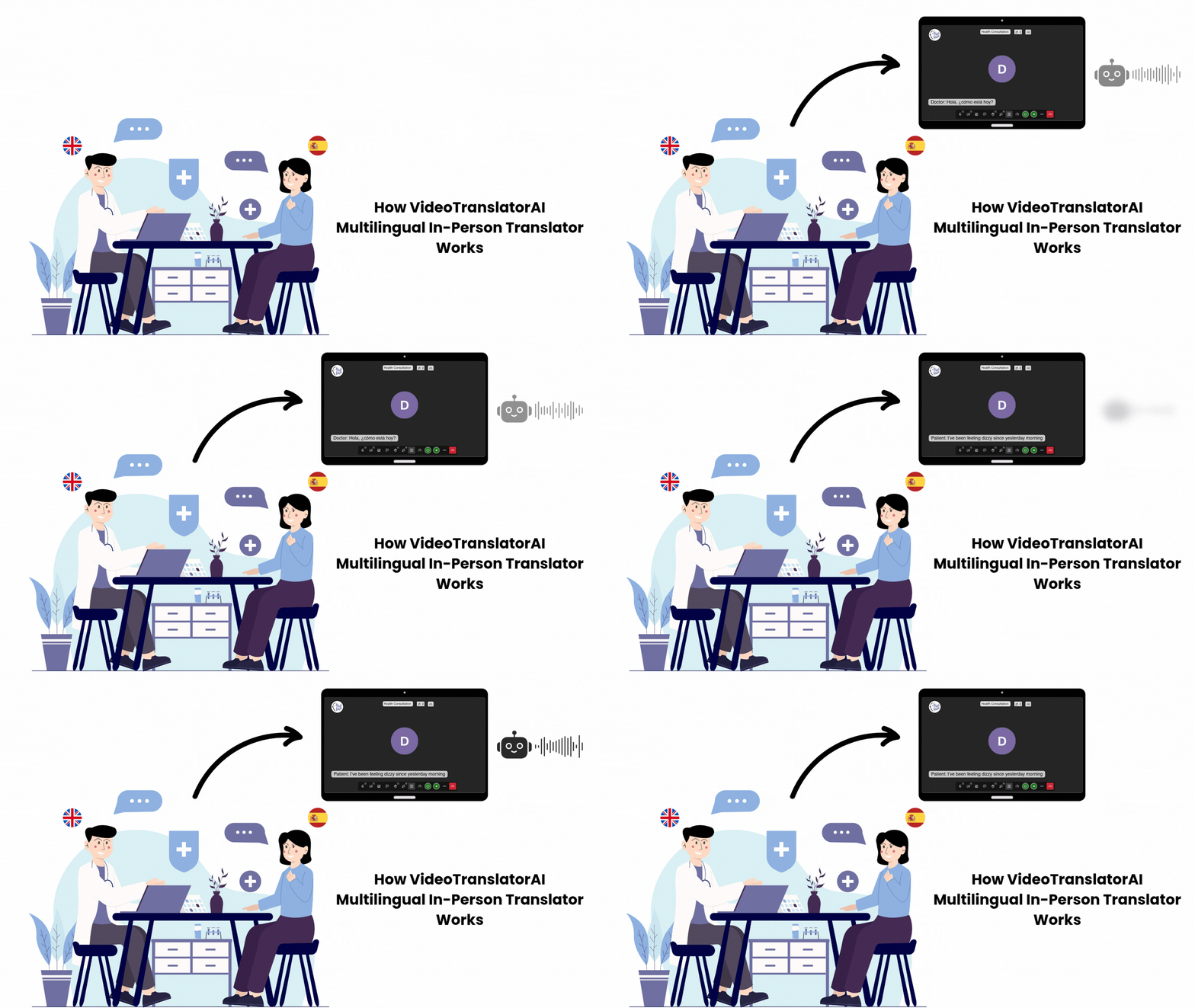
We did not build VideoTranslatorAI to replace translators. We built it to make multilingual communication accessible in settings where it was previously impossible: a nurse trying to explain a diagnosis to a patient who speaks a different language, a small business owner trying to reach a customer overseas, a community health worker trying to run a group session across five different languages simultaneously.
These are not situations where a professional translator was sitting ready and got displaced. These are situations where no translation was happening at all, because it was impractical or unaffordable. The access gap we are trying to close is real, and the people we are trying to serve genuinely needed the tool.
Press enter or click to view image in full size
At the same time, the world is changing in ways that affect professional translators, and pretending otherwise is not honest. The demand for high-volume, routine translation work is increasingly served by AI. The demand for judgment, cultural knowledge, and the kind of taste-based decision-making that determines what is worth translating for whom is not going away. It is, if anything, becoming more valuable.
The problem is that the gap between those two realities is where a lot of skilled, experienced translators are currently sitting, watching their rates fall without a clear path to the higher-value work they are told is waiting for them.
We acknowledge that. It is not a gap we created, but it is one that the industry, including companies like ours, has a responsibility to think about more seriously than it has been.
To the Translator Who Wrote That Comment
Thank you for saying it plainly. Your comment was more useful than most of the optimistic takes I have read on this topic, including what I wrote.
The income collapse is real. The higher-order work is real in potential but not yet real in practice for most people. And the infrastructure that would make it real, the rights frameworks, the revenue sharing models, the platforms that let translators monetise cultural intelligence rather than volume, has not been built yet.
That is the honest picture. It does not mean translation as a profession is finished. It means the profession is in a painful, unresolved transition, and the people experiencing that transition deserve a clearer acknowledgement of what they are dealing with than they have been getting.
The tools will get better. The economic models will eventually catch up. Neither of those things helps someone whose rates have already dropped by half.
That part is genuinely hard, and I do not want to minimise it.
The original comment referenced in this article was left by a Japanese to English translator on the following Medium Article: