Chinese AI is reshaping the economics of intelligence, and small businesses have more to gain from it than most people realise.
Chinese models haven’t beaten every benchmark. But models from DeepSeek, Moonshot AI, Alibaba’s Qwen, and Z.ai are capable enough, dramatically cheaper, and far more accessible than most people expected just a year ago.
The market is learning something important: you don’t need the world’s best model for most tasks. You need one that’s good enough, at a price that makes the automation worth doing.
That changes how small businesses should approach AI right now.
What “Winning” Actually Means
Photo by Brecht Corbeel on Unsplash
For years, the AI race was framed as a contest for the most powerful model. Who has the biggest training cluster?Who’s at the top of the leaderboards this week?
By those measures, the major American labs remain very strong. Enormous capital, advanced hardware access, deep research talent.
But there’s a second way to win a technology market.
You make it cheap enough and accessible enough that everyone starts using it.
That appears to be what Chinese AI is doing. Data from model-routing platforms suggests Chinese models are capturing a growing share of actual usage by companies. The precise figures shift, and no single platform represents the whole market. But the direction is hard to ignore.
Companies are responding. DoorDash has discussed using Moonshot AI for routine work while reserving more expensive models for harder tasks. Lindy reportedly moved workloads from Anthropic to DeepSeek to reduce costs. Indian startups are evaluating Chinese models because token bills are becoming genuinely difficult to sustain.
Chinese AI may not be winning the frontier race. It’s winning the economic one.
The Rise of ‘Good Enough’ AI
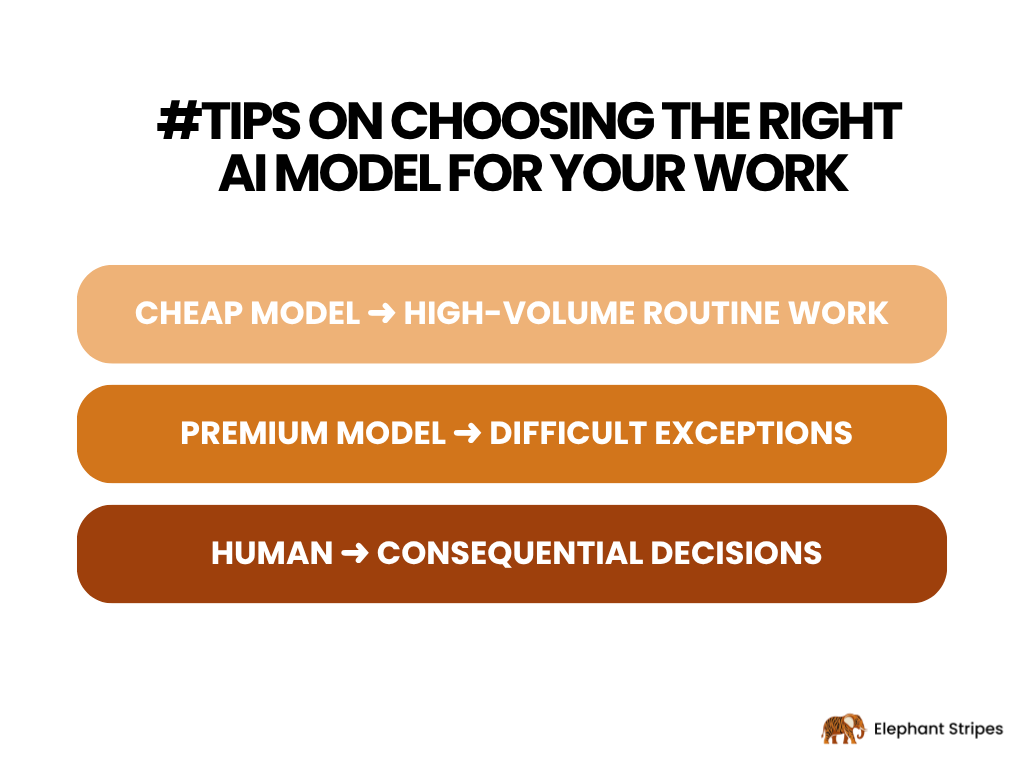
Choosing the right AI model for your work.
This is the central point, and it’s worth sitting with.
Think about the work you actually need AI to do.
Classify incoming emails. Summarise meetings. Extract data from invoices. Draft product descriptions. Answer questions from internal documents. Make routine code changes.
A premium model may do each of those tasks slightly better. But if a cheaper model already clears the quality bar you need, at a fraction of the price, the economics take over.
This becomes even more significant once AI leaves the pilot stage and enters daily operations.
When five people test a chatbot, the token price barely matters. When hundreds of employees use agents throughout the day, when documents are processed at volume, or when customers trigger model calls every few seconds, price stops being a footnote. It becomes part of the architecture.
The practical structure for most businesses starts to look like routing:
Routine tasks go to inexpensive models.
Difficult tasks go to premium models.
High-risk decisions stay with humans.
New Models Stop Being Exciting
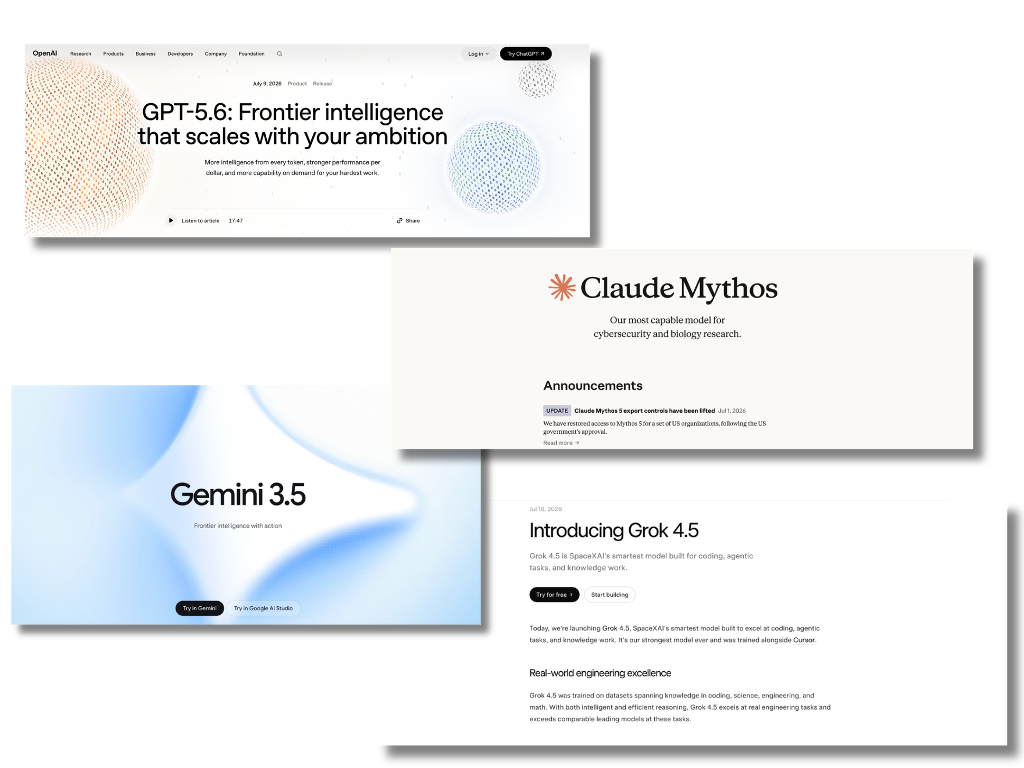
Newest models from the frontier AI labs.
Something shifted in how I think about model releases, and I suspect many builders are experiencing the same thing.
I used to get genuinely excited whenever a new model came out. I would read the announcement, check the benchmarks, and start thinking about what had suddenly become possible.
These days, I rarely feel that excitement.
The models I already have can explain unfamiliar code, investigate a bug, write a migration, draft tests, update documentation, and make straightforward changes across a project. Newer models may handle those things with fewer corrections. But for most of my day-to-day work, the difference is not transformative.
The model is no longer the main constraint.
What actually frustrates me now is everything around the model.
Can it see the right files? Does it understand the objective? Can it work for a meaningful period without drifting off course? Does it recover when a command fails? Can I tell what it changed? Can I control what it costs?
Those questions matter far more to me now than benchmark scores. And they all point to the same thing: the harness.
The Harness is The Real Product
Photo by Daniil Komov on Unsplash
Small businesses most need to understand this concept.
The harness is the operating environment around the AI model.
It decides what the model can see, what tools it can use, what actions it’s allowed to take, what it remembers, and when it needs a human.
For a business, a useful harness connects the AI to documents, email, accounting software, a CRM, or a support system. It also provides the controls around that access: what the AI can read, what it can change, which actions need approval, what gets logged, and how the system recovers when something goes wrong.
Here’s the practical implication.
A cheaper model inside a well-designed harness can be more useful than the world’s best model in a weak one.
If the model can’t find the right information, it produces a confident answer from an incomplete context. If there’s no evaluation layer, you have no way to know whether it’s genuinely improving your process or just generating activity.
As AI models become cheaper and more interchangeable, the harness becomes the main source of lasting value.
The model is a component. The harness is the product your team actually lives with.
Open Does Not Mean Free
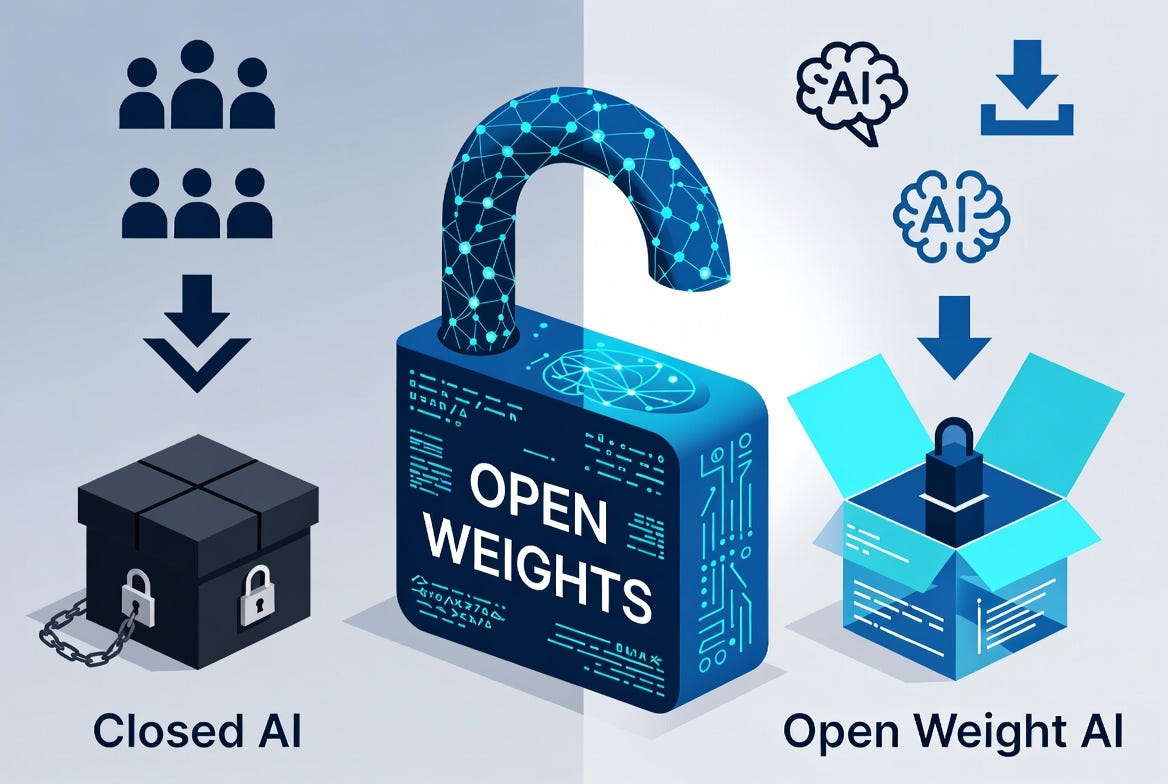
Illustration by author (Generated with GrokAI).
Open-weight models are getting a lot of attention right now, and it’s worth being precise about what “open” means for a small business.
Open weights reduce licensing restrictions and let multiple providers compete on cost. That’s useful. But they don’t eliminate the need for GPUs, hosting, engineering, security, monitoring, and maintenance.
Self-hosting a large model won’t be the right call for most small businesses.
A more practical option is using a Chinese-developed model through a reputable provider in your own region, or through a model router that makes it easy to compare providers and switch between them.
The value of open weights isn’t that every business should own AI infrastructure. It’s that no single company gets to be the only seller of that intelligence.
That creates competition, keeps prices falling, and improves long-term availability.
Eight Moves to Make Now
Photo by Judy Beth Morris on Unsplash
Given all of this, here is practical guidance for any small or medium-sized business trying to navigate the current AI landscape.
Stop waiting for the next model. The capability required to improve many business processes already exists. Start with one repetitive, measurable workflow: triaging support requests, extracting data from supplier invoices, drafting quotes, or preparing first responses to common customer questions.
Define success before choosing a model. How accurate does the result need to be? What happens when it is wrong? When should a person approve the result? Answer these questions before you touch a model selector.
Test a cheaper model against your premium baseline. Do not assume the cheaper model is good enough. Test it on your actual work. But do not assume the premium model is worth the extra cost either.
Use different models for different levels of difficulty. Cheap models for high-volume routine work. Premium models for difficult exceptions. Humans for consequential decisions.
Invest in the harness. Organise the data. Connect the tools. Define permissions. Create approval steps. Keep logs. Build a set of real examples you can use to evaluate every model you try. This is where the real value lives.
Avoid unnecessary lock-in. Keep your business rules, evaluations, data access, and approval logic separate from any single model provider wherever practical. The preferred model can change quickly, as the rise of Chinese AI has demonstrated.
Understand what you are actually deploying. A Chinese-developed model hosted inside your own environment is not the same as a proprietary API hosted in China. Ask where your data goes, who operates the infrastructure, what gets retained, and what legal jurisdiction applies.
Measure completed work, not tokens. The goal is not cheap intelligence. It is better economics in the workflow. Measure cost per resolved support request, processed invoice, or qualified lead. Cheap tokens are not cheap if the output creates more work than it saves.
The Real Lesson
Photo by Solen Feyissa on Unsplash
Chinese AI may not have built the single smartest machine. But it is doing something more immediately disruptive: making useful intelligence cheap and abundant.
For small and medium-sized businesses, that is genuinely good news. More choice, lower costs, and less dependence on a handful of expensive providers.
But it also means that choosing a model is becoming the easy part.
The difficult part is building the harness: the data, tools, permissions, evaluations, and human controls that turn a capable model into a dependable business process.
As AI models become commodities, the advantage will not belong to the business with the newest model. It will belong to the business that knows what to do with it.
Do not wait for the perfect model. Build a useful workflow. Keep the model replaceable. Route each task to the level of intelligence it actually needs. And measure whether the work gets better.
That is the real lesson of cheaper Chinese AI. And it applies whether your model was built in San Francisco or Hangzhou.