
How to Compete When Everyone Has AI
Stop chasing models. Start owning systems.

Three years ago, access to a capable AI model was a real competitive moat. You needed significant budget, technical expertise, and tolerance for unreliable early outputs. Most small businesses could not meaningfully participate.
That has changed faster than most people expected.
Today, small business AI is no longer gated by access to a frontier model. Chinese labs including DeepSeek and Qwen have normalised open-weights releases: trained parameters available to download, host, and adapt under permissive licences. Capable inference is now available from multiple competing providers at prices that make high-volume business use economical.
Then Thinking Machines Lab, an American frontier lab, launched Inkling. Its most interesting feature at launch was not the benchmark score. It was the admission.
Thinking Machines Lab said explicitly that Inkling is not the strongest model overall. Its competitive proposition is a model designed to be adapted and improved inside each customer’s own system.
When a frontier lab stops competing on raw model supremacy, it is worth asking what that tells you about where the real advantage has moved.
When a Frontier Lab Stops Claiming Number One
Frontier AI labs spent years battling for leaderboard positions. Every major release came with charts showing superiority on one evaluation or another. The implicit promise was consistent: pay for access to the best model and you get the best AI.
Inkling’s launch framed the competition differently.
Thinking Machines Lab positioned the combination of Inkling and its Tinker customisation tooling as the product:
A system that a customer can improve specifically for the customer’s work.
The company openly acknowledged Inkling is not the overall leader. It argued instead that a strong, adaptable base model, shaped to a business’s workflow and data, beats a stronger general model that the business cannot meaningfully customise. The unit of competition has shifted from which company built the best general model to which business built the best system for its specific work.
Other American labs have released open weights before. xAI’s Grok-1 and OpenAI’s gpt-oss both preceded Inkling. The point is that growing convergence across Chinese and American labs toward open weights paired with customer-level adaptation signals something durable about where this market is heading.
The Commodity Transition in Plain Terms
Think about any technology that began as scarce infrastructure and became a standard business input. Broadband connectivity. Cloud computing. Software as a service.
Each started as a premium competitive advantage and ended as a cost of doing business that most competitors could access. AI model capability is following that path.
The economics are being compressed by competition between labs, widespread open-weights releases, and the deployment ecosystems that grow around them. The ceiling on what a capable model can do keeps rising. The price keeps falling.
For small and medium businesses, this creates a genuine opportunity. Intelligence is getting cheaper. But it also creates a strategic problem if your AI plan amounts to subscribing to the best available model and hoping that does the work.
When the model is a commodity, the advantage moves to the system built around it.
What “the System” Actually Means
This is the point where most AI business articles go vague. “Build your own AI system” is not a strategy. So it is worth being specific.
Practitioners call the environment around a model the harness. It is the architecture that gives a model governed access to the evidence, tools, and controls it needs to do reliable work.
A functioning harness includes:
Instructions and workflow design that define what task the model is performing
Data connections that bring accurate, current information into the model’s context
Tools the model can use to retrieve facts, run calculations, or query business systems
Permission layers that control what the model can access and act on
Approval steps for decisions with real consequences
Evaluation and logging that lets the business measure and improve performance over time
The model in this architecture is not the product. It is closer to an engine. The competitive asset is the vehicle built around it, with the domain knowledge, operating standards, and customer context of the business encoded into the system’s design.
What a Real Operational Question Looks Like
Here is a concrete example to make the harness tangible rather than theoretical.
Suppose a small business finance team asks: Which product lines lost margin last quarter, what drove the change, and which supplier or pricing decisions need investigation?
A generic chatbot, even with uploaded company documents, cannot answer this reliably. The reason is data shape: financial figures live in structured tables, contracts live in prose, margin calculations need deterministic logic, and current order status lives in a transaction system. A single retrieval method handles none of these well.
A properly designed system routes each question to the right tool.
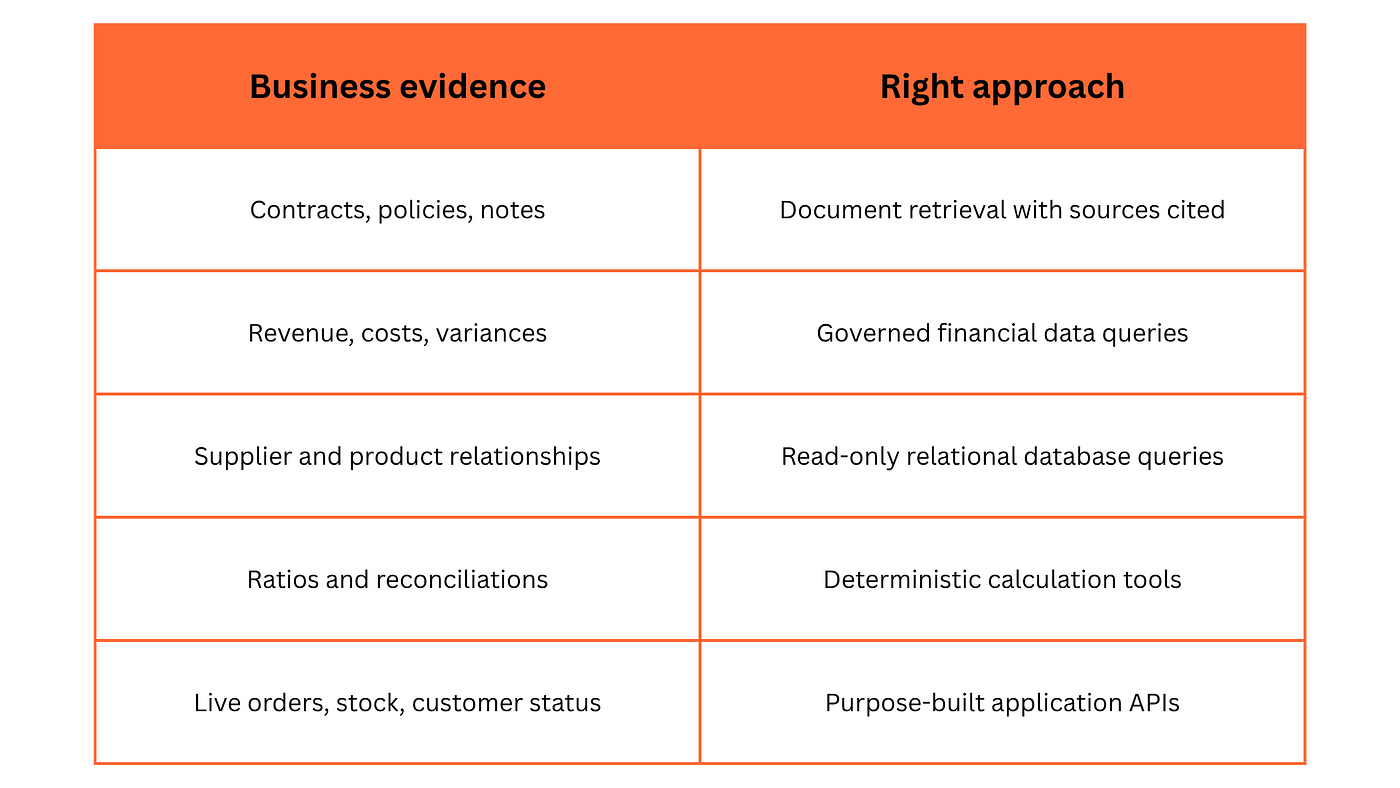
The model plans the approach, selects the tools, and explains the result. The application enforces identity, permission boundaries, query limits, and auditable records. The model is not the database, the calculator, or the security layer.
Building this, even for one workflow, is harder than subscribing to a chatbot. It is also the work that competitors cannot reproduce by switching to the same model provider.
Why Smaller Businesses Have a Real Structural Advantage
Large organisations have more historical data, more staff, and more capital. They also carry more legacy infrastructure, more integration debt, and significantly more organisational resistance to changing established workflows.
A focused SME can pick one decision or workflow with a measurable cost problem, design a precise system for it, and iterate faster than a large competitor can move a similar project through governance and procurement.
The realistic targets for a well-designed SME AI workflow are not theoretical futures. They include:
An accurate quote delivered in hours rather than days
A margin deterioration or supplier problem identified before it compounds in the business
An international customer answered accurately and around the clock using governed, approved content
Compliance or export documentation prepared with full source traceability
A small team producing proposal and research output previously requiring a much larger one
These outcomes do not require the strongest model on the market. They require the right system matched to a specific workflow, with good underlying data and a clear evaluation standard.
A Practical Clarification on Open Weights
One thing worth being clear about before the action section.
Open weights do not make self-hosting economical or practical for most SMEs. The full Inkling model requires at least 600 gigabytes of aggregate GPU memory in its quantised form. That is cluster-scale infrastructure.
The practical value of open weights for a smaller business runs through the market rather than direct download. More providers can host comparable open models, which increases choice and drives inference prices down.
Specialist vendors can adapt open-weights models for vertical industries. And open weights reduce the risk that a single provider can impose unfavourable terms by virtue of being the only option.
Deployment provenance is worth scrutinising regardless. A Chinese-developed model hosted locally under Australian data sovereignty terms is a different arrangement from the same model accessed through a service operated overseas.
Treat model origin, operator location, data handling, and licence terms as separate questions, and ask each explicitly before committing.
How to Build What You Actually Own
Here is a sequence that a small business can fund, govern, and expand without building internal AI research capability.
Choose one workflow with a measurable problem. Slow turnaround, high error rates, too much specialist time on routine assembly work. Define the input, the desired output, and what a wrong answer would cost the business.
Record the current baseline. Time, staff effort, error rate, rework, and business outcome. Without a reference point, you cannot know whether AI is creating or consuming value.
Match retrieval methods to data shape. Documents use one approach. Structured data uses another. Calculations use a third. A single text-retrieval method applied to everything fails on most real business questions.
Build a test set from real cases. Representative questions, correct answers, genuine edge cases, and clearly wrong responses this business must not produce. Treat the test set as a permanent asset, not a setup task.
Test with a capable hosted model and keep it replaceable. Route difficult cases to a more powerful model. Route genuinely consequential decisions to a person. Keep business logic and tool definitions outside the model where practical.
Fine-tune only when you understand the failure mode. Most problems are data problems, retrieval problems, or workflow problems, not model problems. Fine-tuning before understanding the failure amplifies the wrong thing cheaply and quickly.
Expand only after the first workflow works. A polished interface with no measurable business improvement is not a capability. It is a demonstration.
What to Own, What to Let the Market Handle
Summarised as a clear decision framework for any SME leader:
Own the workflow. Know where AI enters the process, what completion looks like, what can fail, and who is accountable for the outcome.
Own the context. Maintain clean source material, governed metric definitions, and controlled interfaces to systems of record. The model’s context window is not a reliable store of business knowledge.
Own the tests. A portable evaluation set grounded in real work is how you compare providers honestly, verify improvements, and negotiate from evidence rather than from marketing benchmarks.
Own the controls. Identity management, data permissions, approval rules, and audit trails belong in the application, not in a prompt that asks the model to behave.
Let the model change. Use whichever option clears the required quality, cost, and risk threshold for each task. Test the market periodically and switch when a better option is available.
Where the Advantage Actually Lives
Inkling is a useful signal because it shows a well-funded American lab responding to the same market reality Chinese labs have been pushing for two years. Capable open weights, customer-level adaptation, and competitive multi-provider inference are becoming the standard shape of the AI market.
The businesses that benefit most from this shift will not be the ones subscribing to the most expensive API. They will be the ones that used the window while models were getting cheaper to invest in what no model can supply: the workflow rigour, the data governance, the evaluation discipline, and the operating knowledge that make intelligence useful at the specific scale and context of their business.
The model is a commodity. Build what is not.