
I Gave My AI Server Access. It Became A Great DevOps Partner.
I Gave My AI Server Access. It Became A Great DevOps Partner.

Naval Ravikant had his AI epiphany in December 2025. He called it “A Return to Code” and described the moment he could ship one-shot custom apps with Claude Code or Codex. It’s a great podcast. You should watch it.
My epiphany hit a few months earlier. Same tool. Completely different use case.
I do not use Codex like a junior developer assistant. I use it as a DevOps partner.
And that shift changes everything.
Why DevOps specifically?
It all started with a server audit.
I was staring at our production server, which runs PM2, Docker, and a handful of different apps, trying to figure out whether our security posture was actually any good.
Were our DNS entries correct? Was our nginx setup tight? Were we caching properly? Were there vulnerabilities we’d missed?
These aren’t coding questions. They’re DevOps questions. DevOps is a discipline with an enormous surface area. DNS, caching, server configuration, CI/CD pipelines, security hardening, and error monitoring.
It touches everything, it requires specialist knowledge across multiple tools, and it has historically been expensive to get right.
You either pay for a dedicated DevOps person, contract a specialist, or you do what most small teams do: wing it and hope nothing catastrophic happens.
The AI cost argument here is straightforward. The human labour involved in proper DevOps oversight used to be substantial.
Now it doesn’t have to be. And it’s because I decided to give Codex access to everything.
Connecting The Whole Stack
I set up access in a fairly straightforward way.
First, a GitHub personal access token so Codex could see what actions were running. Then I built out a Google Cloud project, gave it ownership permissions, and wired up APIs for Google Analytics, PageSpeed Insights, and Tag Manager. After that, Cloudflare access and direct server access.
Five or six services, all connected.
Then I just asked it questions.
“Look across all of these and tell me what our cybersecurity looks like. How do we harden it? What does our caching look like? PageSpeed is flagging these errors. You can see our nginx config. What should we change?”
That was the AHA! moment.
It wasn’t “write me a function” or “fix this bug.”
It was a systems-level conversation across every service we run, all at once.
The Answer was Better Than I Expected
Our CI/CD pipeline is now several orders of magnitude better than it was. The improvements compound: tighter security, better caching, DNS entries that are actually correct, and error monitoring that catches things before users do.
Codex checks the server. It checks available disk space. It flags DNS issues. It reads error logs and tells me what’s wrong.
The amount of human labour this replaces is significant. It doesn’t do everything, but it closes the gap between “something is probably wrong somewhere” and “here’s exactly what’s wrong and here’s how to fix it.”
I genuinely can’t believe more people aren’t using AI for DevOps.
Building the CMS I Actually Wanted
The DevOps breakthrough changed what I thought was realistic to build and maintain.
Our website had been through a few different configurations. It started as a Hugo site: static, markdown-powered, genuinely fast. Then we moved to Forestry for proper CMS features. Then to Strapi because VideoTranslatorAI needed proper multilingual publishing support. That meant a Strapi and Gatsby stack, and the maintenance overhead was significant.
Then Gatsby started to quietly lose momentum as a project.
That was the point where I stopped trying to maintain the existing setup and built something new from scratch.
The process was iterative. Build what you think you want. Use it for a while. Discover the gaps you hadn’t imagined. Close them. Repeat.
What came out the other end is a bespoke CMS with email capability built in, no dependency on third-party projects that might stop being maintained, and performance numbers that most agencies would be proud of.
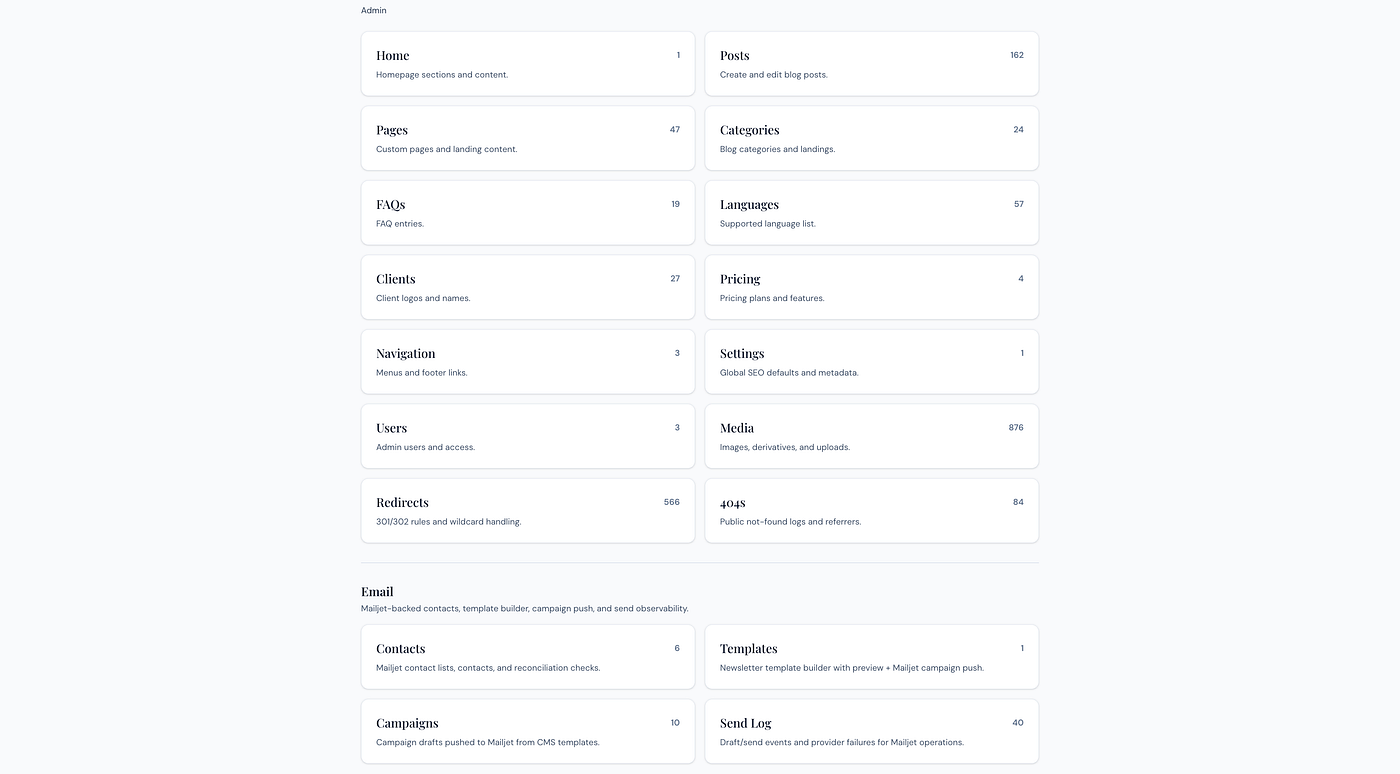
PageSpeed scores are excellent. The site is fast in a way the Strapi-Gatsby setup never was. It does exactly what we need. The maintenance overhead compared to what we were running before is dramatically lower.
Human labour: down. AI cost to maintain: minimal.
You Can Have This Too
If you want a CMS built the same way, with the performance, the bespoke fit, and none of the bloat, that’s exactly what Elephant Stripes does.
Elephant Stripes is a bespoke app development service. We don’t sell templated solutions. We sit down with you, usually for a few hours in the first session, and we build in front of you. You see it take shape in real time. You can redirect it, add to it, and push back on scope when needed.
By the end of that session, you know what you’re getting. You’ve seen it built. And the gap between what’s in your head and what ends up in production is a lot smaller than it would be if you handed over a spec doc and waited six weeks.
If that sounds like something you need, reach out via Elephant Stripes!
The Bigger Point
Naval frames the current moment as a renaissance for individual software creators. I think he’s right, but the frame is slightly too narrow.
Coding has been democratised, and so have operations, infrastructure, and systems oversight; the disciplines that used to sit between developers and the rest of the business.
The teams that realise that AI isn’t just a code editor but an entire operational layer will build much stronger foundations than those who use it only for features.
Vibe coding got me back into building. DevOps is what made the building worth doing properly.
That’s the part nobody’s writing about.
If you want the full context behind these ideas, you can listen to Naval Ravikant’s A Return to Code podcast here: https://nav.al/code
I also shared my complete reaction and breakdown on YouTube: