
The Quiet Desperation of Job Hunting in 2026
Why talented people keep getting filtered out

A few days ago, I came across a post by Jeffrey Bakker on Medium that hit closer to home than I expected. It is an eight-minute read and well worth your time. Bakker documents what so many people have been quietly experiencing: the process is broken, the tools are stacked in favour of employers, and most job seekers are navigating an increasingly automated system without any equivalent tools on their side.
His article confirmed what I have been watching happen, and it pushed me to write something of my own.
Read Bekker's piece here: Job Hunting in 2026: AI Is Everywhere, and Mostly Working Against You
I have been building a tool called JobsLobster. Before I get to that, I want to spend some time on the problem itself, because I do not think it gets taken seriously enough.
What Job Hunting in 2026 Actually Feels Like
The five stages of grief are not a metaphor when you are job hunting in 2026. It is a pretty accurate description of the emotional arc most people go through.
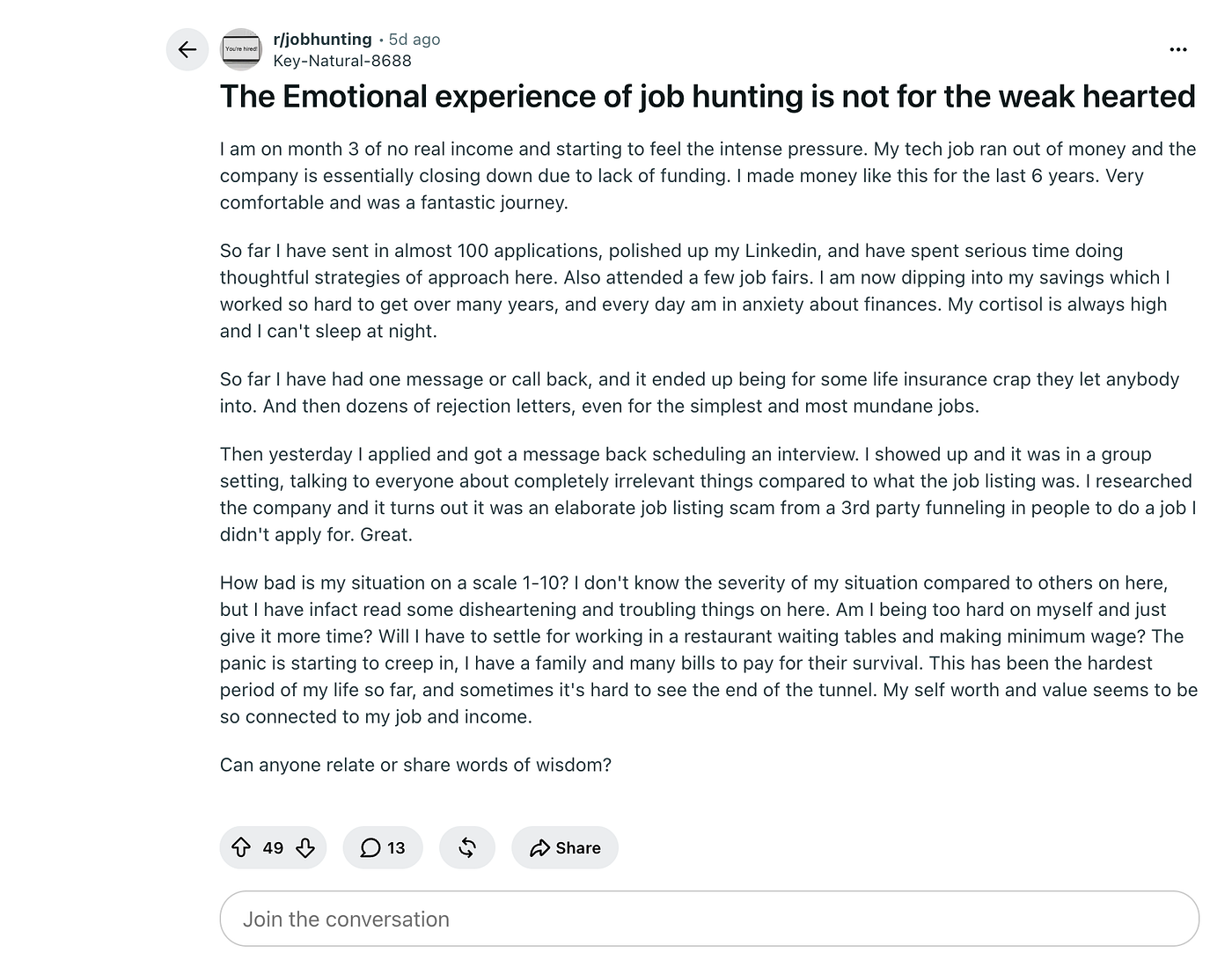
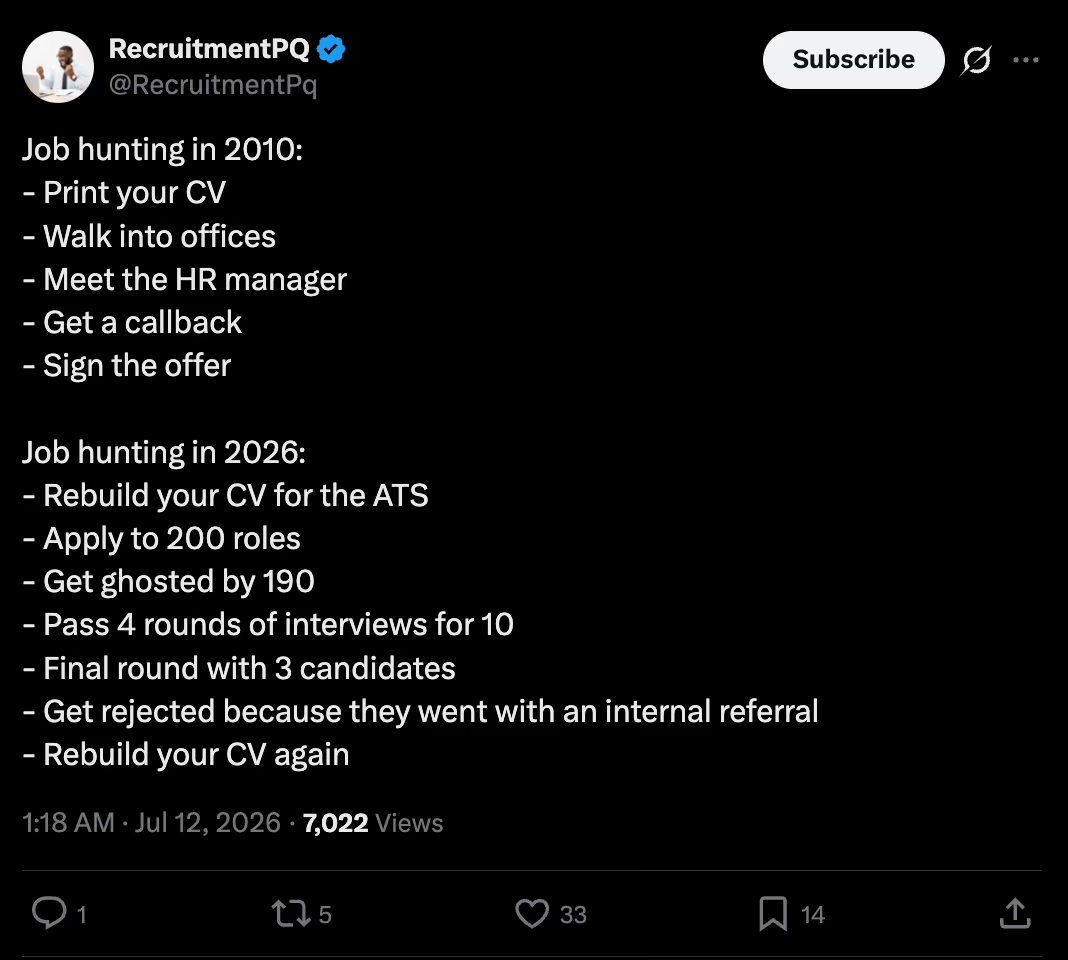
The numbers are brutal. Cold online applications now have a success rate as low as 0.1%. The average job seeker is submitting over 150 applications to land a single offer. You send out 150 applications and get three rejections plus radio silence.
Meanwhile, the hiring process has quietly automated itself into something that feels almost designed to filter people out before any human ever gets involved. AI and mass applying mean most resumes never reach a human, and even interviews are increasingly handled by bots.
For job seekers, that has meant fewer responses, less transparency and growing uncertainty about how, or whether, to use AI themselves..
And here is the cruellest part of the current dynamic: The majority of roles above $80K are filled through referrals, recruiters, and internal mobility rather than public job boards.
So the game most job seekers are playing, such as optimising their resume, applying through LinkedIn, checking Indeed every morning, is the wrong game entirely. The jobs that matter most are not even visible in the places most people are looking.
AI Was Supposed to Help. It Mostly Helped the Other Side.
This is the part that genuinely frustrates me.
AI has transformed the recruiter side of hiring. Applicant tracking systems have gotten dramatically better at filtering. AI screening tools can process thousands of applications in minutes. Automated ranking systems score candidates before a human eye ever touches the file.
The job seeker side? Mostly they got AI resume polishers that take their existing resume and make it shinier. Which sounds helpful until you realise the underlying problem is not resume polish. It is that a two-page document is a terrible representation of what a person actually brings.
Think about what a resume is. It is a compressed, simplified, necessarily incomplete summary of a career. Most people write it under time pressure, undersell themselves significantly, and leave out entire categories of relevant experience because they are not sure how to frame it. Then they apply it to a job description that was written by a committee and filtered through an ATS that is looking for specific keyword matches.
The mismatch between what a person can actually do and what their resume conveys is enormous. And for years, nothing on the job seeker side has addressed that gap seriously.
The real problem is not that there are too many candidates. It is that too many capable people never get the chance to show what they can do.
That sentence is why we built JobsLobster.
What We Are Trying to Do
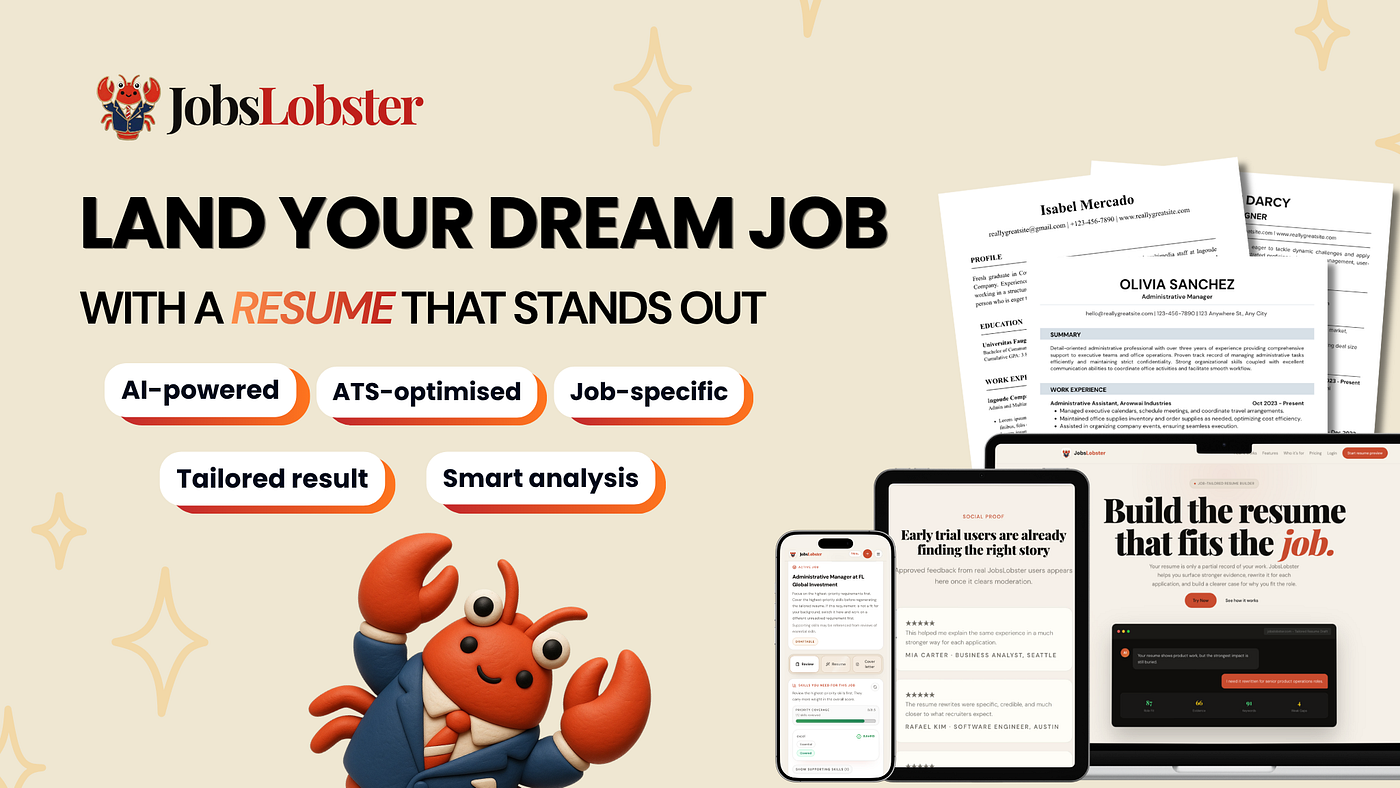
JobsLobster is a resume builder that starts from a different premise: your resume is not the starting point. You are.
Here is how it works.
You upload your current resume and paste in the job description for the role you are applying for. The AI agent analyses the gap between what your resume currently shows and what the specific job is actually looking for. Not just keyword matching. A real analysis of where your documented experience speaks to the role and where it falls short.
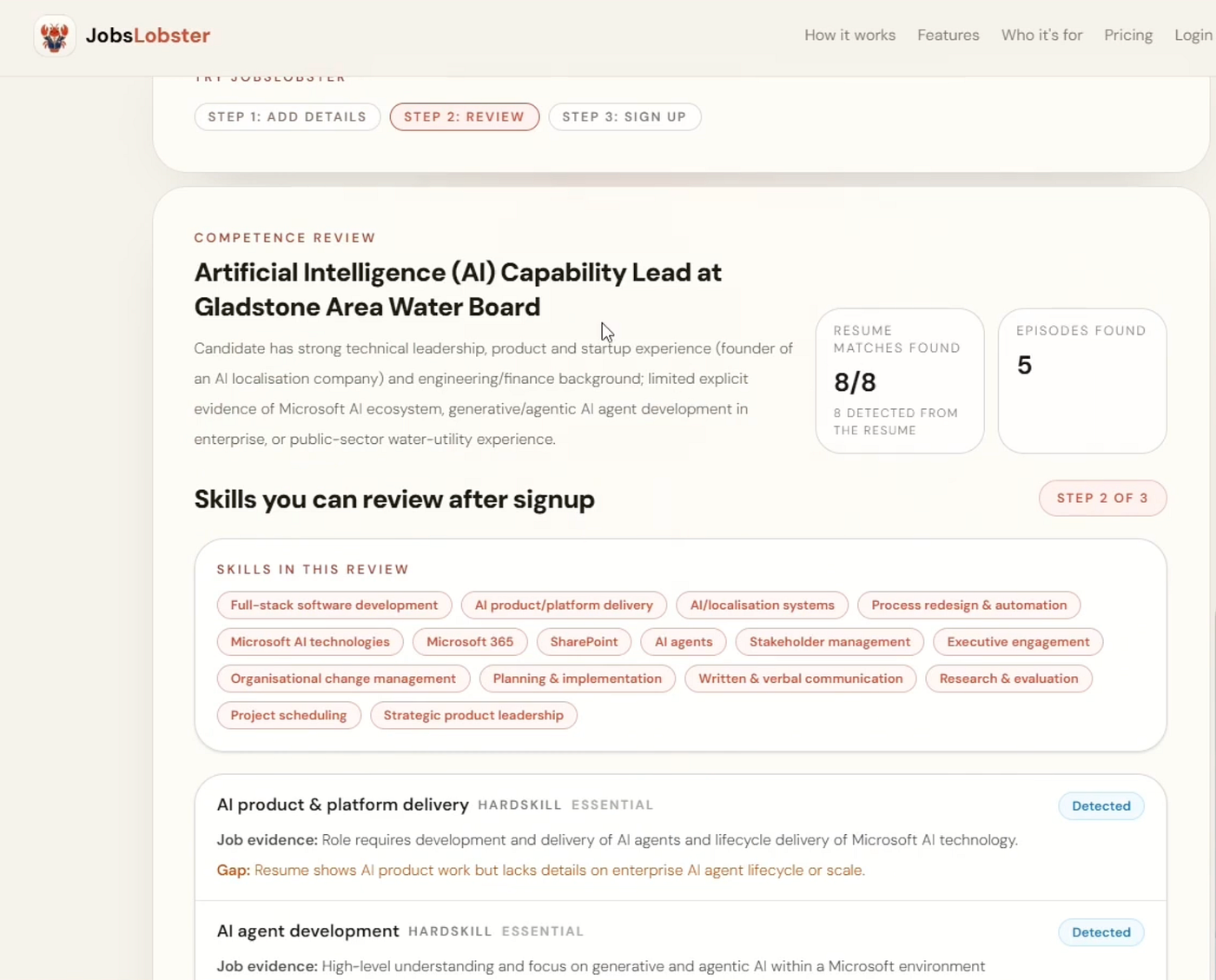
Then it asks you questions.
This is the part that makes it different from every other tool I have seen. Because most of the time, the gap between your resume and a job description is not a gap in your actual experience. It is a gap in your documentation. You have done the relevant work. You just never wrote it down properly, or you wrote it down in a context that does not obviously translate to this particular role.
The agent surfaces those gaps specifically and asks you to fill them in with your own words. Tell me about a time you managed something like this. Walk me through how you approached that kind of problem. What did that project actually look like from your end?
Your answers get remembered. Every conversation, every detail you share about your career gets stored and used for future applications. So the second resume you build is better than the first. The fifth is better than the second. The agent is building a richer and richer picture of who you actually are, not just what fits on two pages.
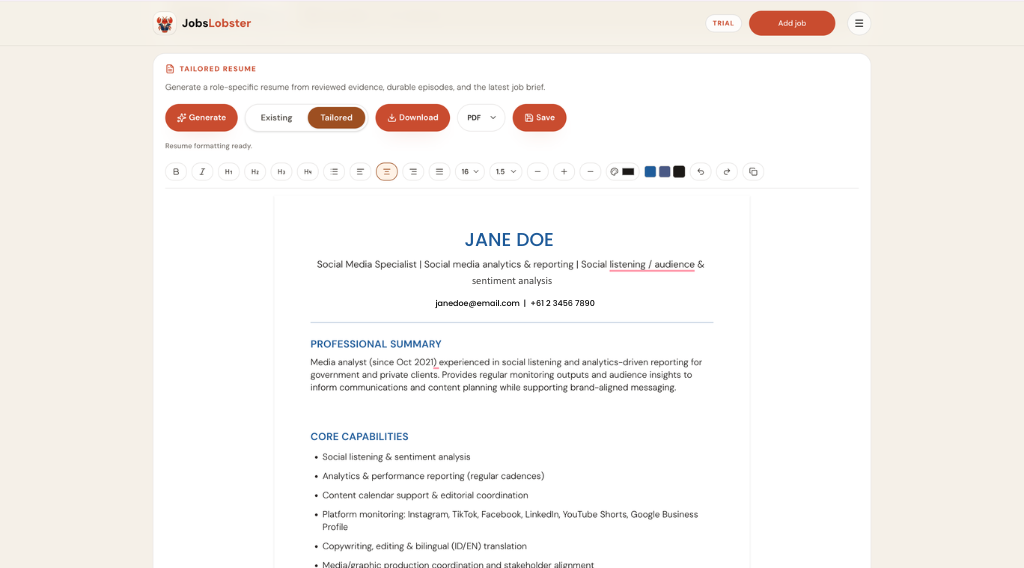
Beyond the resume itself, JobsLobster generates a tailored cover letter for each application and runs a mock interview simulation based on the specific job description. So you can practise answering the questions this particular role is likely to generate, before you are in the room.
Why We Built It This Way
Recruiters have serious tools. AI screening, automated ranking, and ATS systems that have been refined over the years. The asymmetry between what the hiring side has and what the job seeker side has is real and significant.
The playbook changed. Most job seekers are still running the old one.
JobsLobster is an attempt to give job seekers something that actually matches the sophistication of what they are up against. Not a resume template. Not a keyword stuffing tool. A system that understands you specifically, builds your profile over time, and helps you present the full scope of what you bring to each individual role you apply for.
The people stuck in the application loop are not usually stuck because they lack capability. They are stuck because the system makes it brutally hard to communicate that capability clearly.
A generic resume going into an ATS is not a fair representation of a genuinely talented person. We are trying to build the tool that changes that.
Still Early, Still Listening
JobsLobster is still in active development. I want to be honest about that.
The core functionality is working: resume upload, job description analysis, gap identification, question-based profile building, tailored resume generation, cover letter, and mock interview. The agent memory is working. The job-tailored output is working.
There are things we are still improving. The UI is getting cleaner. The question quality is getting sharper. The output formatting is being refined based on what users find most useful.
This is exactly the stage where feedback matters most. If you try it and something does not work the way you expected, or something works well, and you want more of it, that feedback shapes what we build next.
A free trial is available at jobslobster.com, with three applications per week. No credit card required to start.
If you are currently in the job-hunting trenches, I genuinely hope it helps. And if you have thoughts on what it should do better, I am listening.