
Translators vs. AI Reality
What translators are experiencing is a preview of where this is all heading

Last week, I wrote an article called “A Translator Called Me Out, and They Were Right.” I expected some disagreement. I expected the usual pushback about AI being inevitable, about adaptation being necessary, about how technology always creates more than it destroys.
What I did not expect was the volume and consistency of what came back.
Professional translators across LinkedIn responded with the same core message: you still do not fully understand how bad this has become.
Honestly, I think they are right about that, too.
The Feedback Was Not Abstract
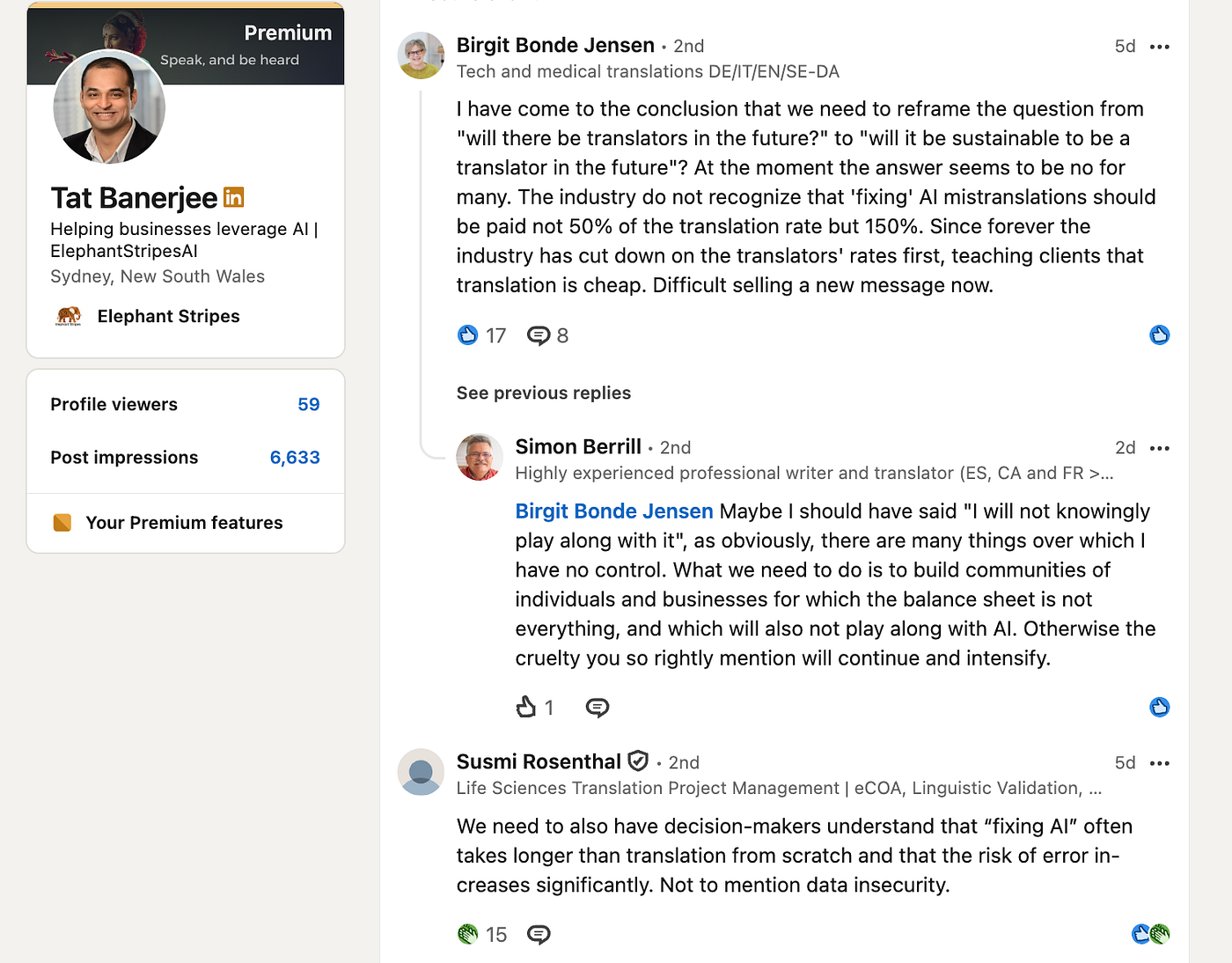
The responses were not theoretical concerns about some distant AI future. They were people describing a profession being economically hollowed out right now, in real time, in measurable ways.
I think the AI industry needs to sit with that, rather than immediately pivoting to optimism, which appears to be our default.
One comment reframed the conversation in a way I keep coming back to. She said: we need to stop asking “will there be translators in the future” and start asking “will it be sustainable to be a translator in the future.”
That is an entirely different question. And it is the right one.
Most AI discussions still frame everything around replacement, as in, will AI replace translators? But the people actually living through this are talking about sustainability.
Can you still earn a middle-class income doing this work? Can you still build a career around it? Can you justify the years spent mastering languages, culture, specialisation, nuance, domain expertise?
These are economic questions. Not technological ones. And the AI industry often avoids them because they are much harder to answer.
The Productivity Trap
One of the most repeated ideas in AI is that AI handles the repetitive work so humans can focus on higher-order work.
You hear this constantly. “Let the AI do the simple stuff. You do the complex stuff. Unlock creativity. Add strategic value.”
The translators who responded pointed out the gap in that argument that I had glossed over. The industry never explains what the compensation model for that higher-order work actually looks like.
Because here is what is actually happening in post-editing work, which is the role many translators have been pushed toward: You are no longer translating from scratch. You are reviewing AI output. Monitoring for subtle errors, hidden inaccuracies, awkward phrasing, cultural mismatches, false fluency. The market response to this has largely been: you touched fewer words, therefore we pay you less.
There is a logic to that from a buyer’s perspective. But from the worker’s perspective, the work has not actually become easier. In many cases it has become more mentally draining. You are not reading your own prose for errors. You are reading AI output that often looks correct on the surface while containing mistakes that require genuine expertise to identify.
One commenter described it precisely: “You are constantly monitoring for things that look right but are not. That is cognitively exhausting in a different way from translation itself.”
The result is a profession that has become harder while simultaneously becoming less economically valuable. The efficiency gains do not flow to the translator. They flow upwards, to buyers, to platforms, to whoever controls distribution. The translator absorbs the cognitive load and hands the savings to the client.
That combination is not sustainable. And the translators are saying so clearly.
The Cruelty of the Transition
Several responses touched on something I think deserves to be named directly.
Some commenters used the word “cruel” to describe the specific emotional dynamic of the current transition. I think that word is accurate, and I want to explain why.
These translators are not anti-technology. They are not refusing to adapt. They are not Luddites. Many have used computer-assisted translation tools like TRADOS for years. They adopted translation memory systems, terminology databases, workflow automation. They welcomed tools that made them better at their work.
The argument is not that technology is bad. The argument is that the economic value of their labour is collapsing faster than new forms of value are emerging.
And what makes it cruel is the contradiction they are being asked to hold simultaneously. The industry tells them: your expertise matters, human nuance still matters, cultural understanding still matters. And while that message is being delivered, their rates are collapsing in real time.
Being told your skills are irreplaceable while watching your income decline is a psychologically specific form of damage. It is not the same as being told you are redundant. It is being told you are valuable while being paid as if you are not.
The Training Problem Nobody Wants to Say Plainly
Several translators raised something that the AI industry still does not particularly like discussing openly.
Their work is being used to train the systems that are replacing them.
One commenter put it in a way that has stayed with me: “every edit, every correction, every quality adjustment is being squeezed for intelligence and fed back into the engines.”
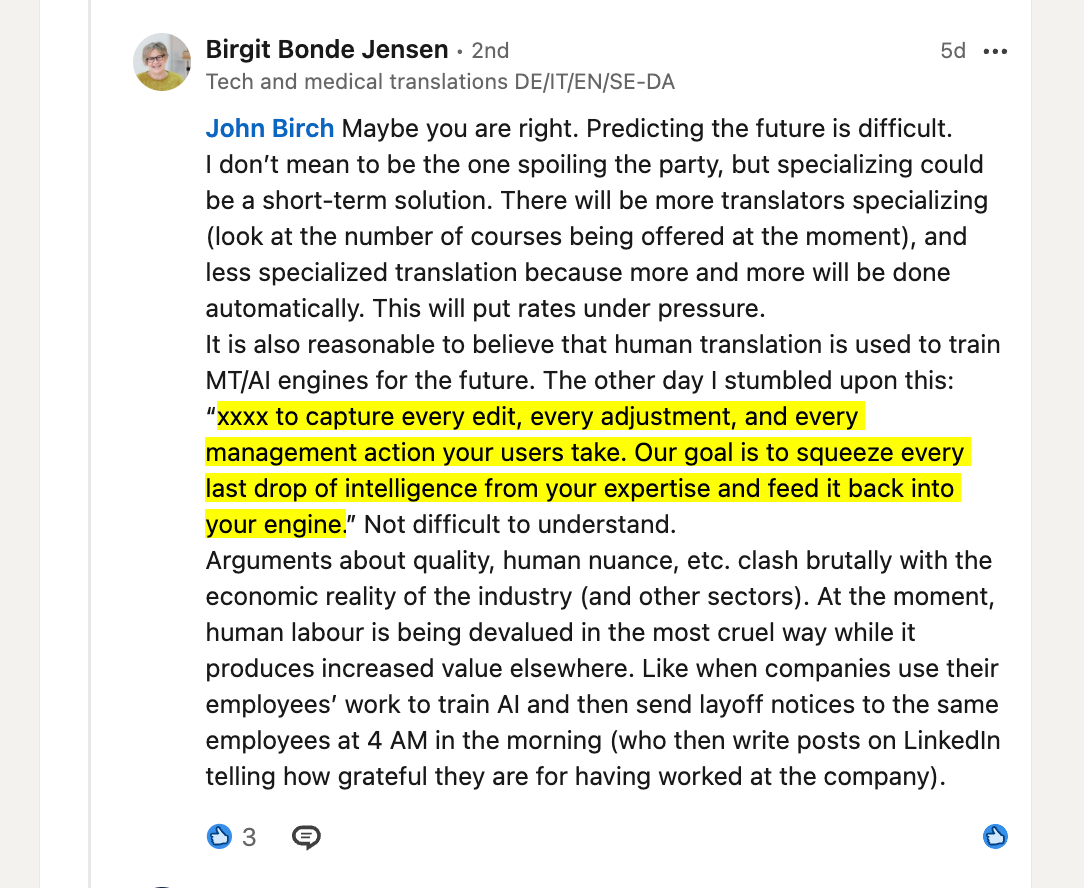
That sentence is uncomfortable. It points to something structurally different about AI compared to earlier tools.
Historically, tools amplified labour. A word processor made you faster at writing. A CAT tool made you faster at translating. The tool served the worker.
AI increasingly absorbs labour. Every correction a translator makes to an AI output potentially improves the model. Every high-quality translation they produce potentially reduces the future dependence on translators who produce that kind of quality. The worker trains the system that is competing against them.
Whether you think this is inevitable, good, bad, necessary, or some complicated mix of all of those things, it fundamentally changes the relationship workers have with the technology. Using the tool can feel indistinguishable from participating in your own displacement.
That is a very different psychological contract than any previous generation of workers has been asked to accept.
The Bigger Economic Question
Several comments across platforms raised a question that sounds dramatic until you sit with it.
“If AI keeps reducing the value of human labour across industries, who actually has money left to participate in the economy?”
Translation, writing, design, programming, support work, research, media, and coordination tasks. The jobs being impacted are predominantly white-collar knowledge work roles.
The core tension is this. AI massively increases productive capacity. But capitalism still distributes income primarily through labour. So what happens when society becomes more productive while human work becomes less economically valuable?
This is not a translation industry question. It is an economic question that affects many industries, and I do not think we have great answers to it yet. But it is an important question, and translators are asking it from the front line.
The Canary is Already in the Mine
One reason translators deserve particular attention right now is that they are simply earlier than most knowledge professions at the bleeding edge of this transition.
Translation is one of the first knowledge professions to experience full-scale AI commodification. The outputs are digital. The evaluation criteria are probabilistic. The work maps extremely well onto what large language models are structurally good at. That is why the disruption hit translation so hard and so fast.
Translators are effectively living through a future that many other professions are only beginning to glimpse.
What they are telling us is this: the technological transition is moving much faster than the economic transition. The tools arrived. The compensation models have not. The rights frameworks have not. The labour protections have not. The new ownership structures have not. And the people caught in the middle are absorbing the shock personally.
Two Things Can Be True at Once
I want to be clear about where I stand, because this matters given that I build AI tools, including VideoTranslatorAI.
I still believe AI translation creates enormous positive value. VideoTranslatorAI started as an interpretation tool for clinicians when a professional interpreter was not available. That gap was real. The access it provides to patients who would otherwise have had no interpretation at all is genuinely good. I believe that multilingual communication becoming more accessible is broadly positive for humanity.
But I also think it is entirely possible for technology to create real societal value while simultaneously causing genuine economic pain to specific groups of people. Both can be true at the same time.
The translators who responded to my article deserve credit for forcing that contradiction into the open. For refusing to let the AI conversation stay comfortably abstract. For saying plainly that while the rest of the industry is discussing productivity, they are discussing survival.
Those are not the same conversation.
Thank you to every translator who took the time to respond. The quality of your feedback changed how I think about this, and that is the point of writing publicly about hard things.
Their valuable thoughts are available under the LinkedIn post I posted this week. If you’re interested in reading the whole discussion, click here.