
We Still Don’t Know If AI Is Our Servant or Successor
And that uncertainty is the real story

Two billboards went up in New York City recently, and the image of them together has been circulating ever since because it captures something that a thousand think pieces have failed to say as clearly.
The first is sleek, dark, and almost cinematic. An AI-generated face with perfect symmetry stares out. Above her, three words in bold: “Stop Hiring Humans.” Below is the tagline: “The Era of AI Employees Is Here.”
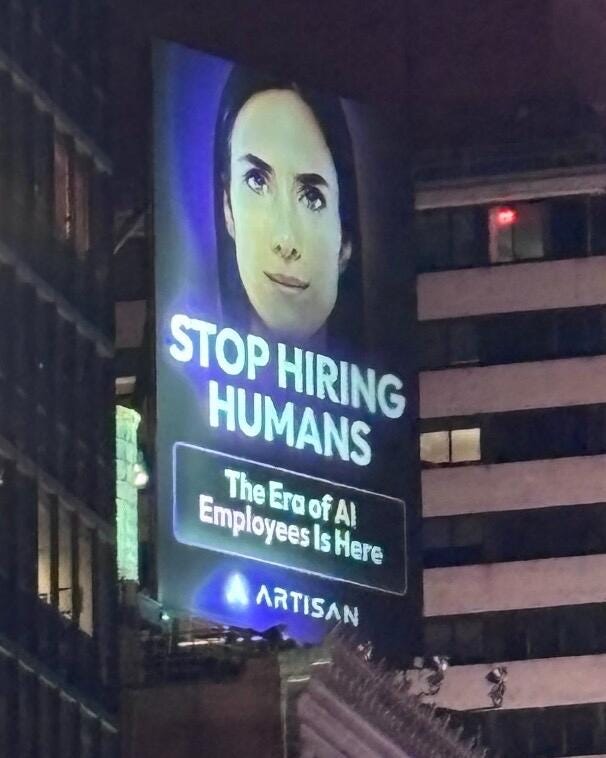
The company is Artisan, an AI startup selling what it calls “AI employees” to replace human workers. The billboard is not trying to be subtle. It wants your payroll budget, and it is not embarrassed to say so.
The second billboard, in contrast, is light-coloured. It’s a sad stick figure holds a cardboard sign: “Will Create 4 Food.” Floating above it, mock chat bubbles styled like a corporate memo: “Thank you artists for donating your life’s work to our AI. Your generosity hasn’t gone unnoticed. Just uncompensated.”
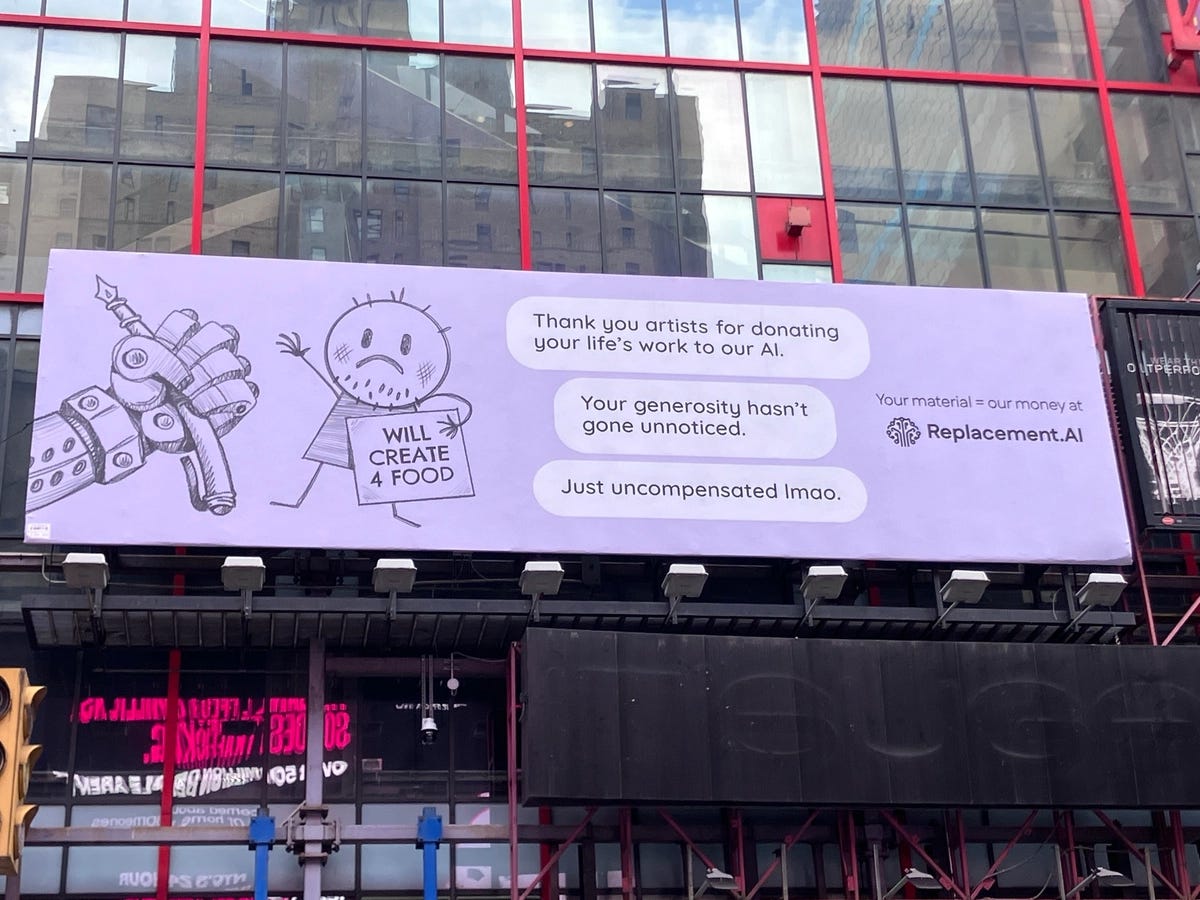
This one was paid for by anonymous artists behind a project called Replacement.AI. They are not selling anything. They spent their own money to put that message in one of the most expensive advertising spaces on earth. Their website describes itself as “the only honest AI company.”
Two billboards. Between them is the argument that has not been resolved: whether what is being built is a tool or a replacement, a future or an ending.
What Actually Went Into These Models
The second billboard points to something real, and it deserves to be addressed directly rather than sidestepped.
The AI models powering the tools that promise to replace human workers were trained on an extraordinary volume of human-made content. Writing, art, music, journalism, code, conversations, arguments posted online at three in the morning. This ingestion happened fast, in server rooms, while most people were clicking “I Agree” on terms and conditions nobody reads.
In a submission to the House of Lords, OpenAI acknowledged plainly that training today’s leading AI models without copyrighted materials would have been impossible.
The courts are beginning to reckon with this. Over 30 copyright infringement lawsuits have been filed against AI developers. Getty Images sued over 12 million scraped photographs. The New York Times sued OpenAI.
In January 2026, Universal Music filed a $3.1 billion lawsuit against Anthropic, alleging its models were built on a foundation of unlicensed music. None of these cases has reached a final verdict. The legal system moves at human speed through a problem that was created at machine speed.
This matters not as an abstract legal question but as a practical one. The creative output that made these models useful came from people who received nothing in return for it. The second billboard is not being melodramatic. It is being accurate.
The Predictions That Contradict Each Other
What makes the billboard image so powerful is that it sits at the exact point where expert opinion collapses into honest uncertainty.
Goldman Sachs estimates AI could displace the equivalent of 300 million full-time jobs. The World Economic Forum projects 92 million jobs displaced by 2030 but 170 million new ones created, a net gain, on paper at least. Dario Amodei at Anthropic has warned that AI could replace half of all entry-level white-collar roles within five years. In contrast, Jensen Huang at Nvidia argues that greater productivity historically creates more hiring, not less.
Both billboards are right, which is the uncomfortable part. The cold efficiency promise and the stick figure holding a cardboard sign are not competing fictions. They are two real things happening simultaneously to different people.
The New Problem Nobody Planned For
There is a second-order problem now developing that was not part of the original conversation.
The large language models (LLM) that power modern AI are hungry for training data, but human-created internet content cannot keep pace with the appetite of systems that do not sleep.
So the models are starting to train on AI-generated content, iterating upon their own outputs, creating a feedback loop that risks losing the human spark that made them genuinely useful in the first place.
What gets compressed out in that spiral is the thing Replacement.AI was trying to protect: the grief, the wonder, the weirdness, the specificity of human experience pressed into language.
Media organisations have noticed. The New York Times is now partnering with Amazon’s AI. News Corp with Meta. Reddit with Google. The finite supply of quality human-generated content is being licensed rather than scraped, which is a more honest arrangement.
But it doesn’t resolve the underlying tension between the velocity of AI development and the pace at which humans, institutions, and legal frameworks can adapt.
Where I Stand After Building This Stuff Every Week
I build custom AI software for businesses. I have seen what these tools genuinely do well and where the optimism is ahead of the reality.
The honest version of my view is this.
AI is a genuinely powerful tool for eliminating drudgery, handling high-volume repetitive tasks, and compressing the time between an idea and a working prototype. For a small team or solo operator, the leverage it provides is real and significant.
AI is not, in any current form, a full successor to human judgment, empathy, accountability, or the kind of creativity that comes from having lived a life with consequences.
The face on Artisan’s billboard doesn’t need to ground herself after a hard week. She doesn’t need anything. What is being sold there is not intelligence. It is the absence of need. That is genuinely useful for some tasks and genuinely inadequate for others, and the gap between those two categories is where most of the consequential decisions get made.
The advice I give clients consistently is the same. Use AI to remove the boring parts of what your people do, then ask what new value your people can create with the time that frees up.
Do not ask which roles you can eliminate. Ask what becomes possible if you remove the drudgery. The second question tends to produce better outcomes and better companies.
Keep humans in the loop for the decisions that matter: client relationships, ethical oversight, final judgment on anything consequential. Not because AI cannot simulate those things, but because accountability requires a human who can be held responsible, and that structural fact is not going to change regardless of how capable the models become.
The Argument is Still Open
The artists behind Replacement.AI spent their own money to put a stick figure in Times Square because they felt the argument was being conducted without them.
They were right about that. The debate about AI’s impact has largely been conducted by the people building and funding these systems, with the people most affected by them treated as a data point in a projection rather than participants in a decision.
Both billboards represent real positions held by real people with real stakes in the outcome. The question of whether AI is being built as a tool or as a replacement is not settled by the technology itself. It is settled by choices: company by company, policy by policy, workflow by workflow.
The experts cannot agree on where this ends. The lawyers are still filing. The models are still training on whatever they can find. And somewhere in Times Square, a stick figure holds his sign, waiting for someone walking past to stop long enough to read it.
That is not a metaphor for despair. It is an invitation to be one of the people who stop.
The two billboards described in this article were reported and photographed by Kay Rubacek via The Epoch Times and republished by ZeroHedge on 25 May 2026.