
How to Make AI Actually Know You for Job Applications
The persistent memory approach that changes things.

You find a role that feels right. The salary works. The team looks decent. The job description reads like it was written for you.
So you open your resume.
And then comes that familiar sinking feeling. The resume you have was built for the last job you applied for. Or maybe the one before that. It’s close. But it’s not quite right for this one. You’re going to have to rewrite it. Again.
This is where most job seekers lose hours they didn’t have to spare. And often, where they quietly lose the role too.
There’s no shortage of AI resume builders promising to solve this. But most of them do the same thing: take your existing resume and make it sound a bit shinier. They tighten the language, sprinkle in keywords from the job description, and call it tailored.
That’s useful, sure. But it’s not really solving the problem.
The Real Problem isn’t Your Resume. It’s Your Memory.
Here’s what’s actually going on.
Over the course of your career, you’ve done a lot. You’ve shipped projects, led teams, solved problems, and worn hats that were never in your original job description. You’ve built things, fixed things, and figured out things on the fly.
But virtually none of it is written down in a single place.
Your resume is a snapshot. Usually two pages. Usually written in a hurry. And almost always trailing well behind what you’ve actually done. It captures some of your work. A handful of highlights. A selection of skills.
What it doesn’t capture is the full picture.
Think about it this way. Imagine you had a 40-page document tracking everything: every project, every role, every unexpected responsibility you took on, every skill you quietly built over the years. From those 40 pages, pulling out the perfect two-page resume for any given role would be straightforward.
You’d have so much to work with that the right version would practically write itself. It would take the best things you’ve done and cast you in the best possible light, every time.
That’s the idea: a new wave of AI job tools is finally starting to chase. Not just resume polishing, but something more like persistent career memory.
What “Persistent Memory” Actually Means for Job Seekers
The concept is simpler than it sounds.
Instead of treating each job application as a one-off task, the smarter approach is to build an ongoing picture of who you are professionally. An AI agent you talk to over time. One that learns about your history, your projects, your strengths, and yes, your gaps too.
The more you tell it, the better it understands you. The better it understands you, the more precisely it can represent you to any employer, for any role.
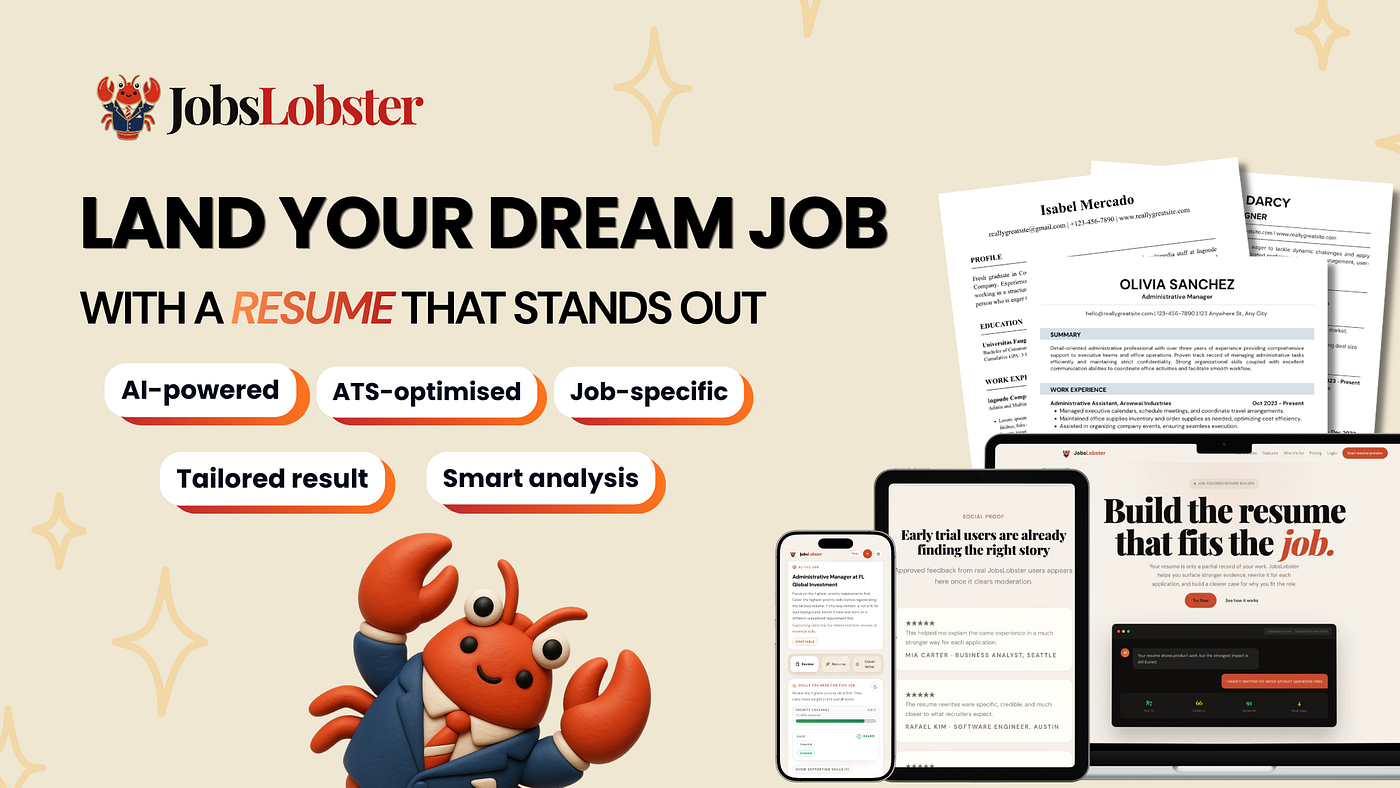
This is the thinking behind JobsLobster, a new tool being built by Elephant Stripes. It’s still early, and we’re transparent about that. But the core idea is genuinely different from what most AI resume tools are doing today.
The goal isn’t just to help you write a tailored resume. It’s to create a living knowledge base about your professional life that gets richer every time you use it.
How It Works in Practice
The process starts simply. You upload your existing resume and paste in a job description. No complicated integrations. Just two inputs and you’re underway.
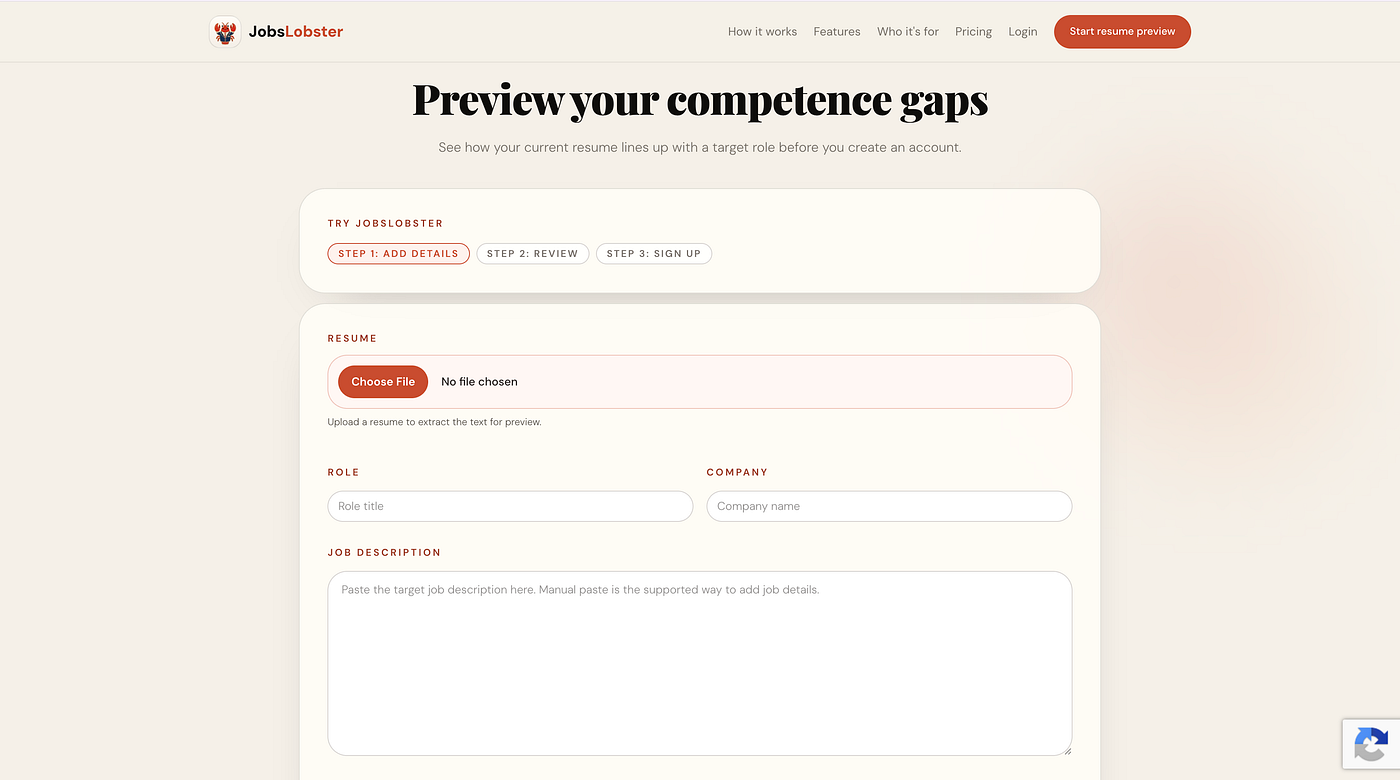
From there, the app does something most resume tools skip entirely. It generates a capability map.
This is where it gets interesting.
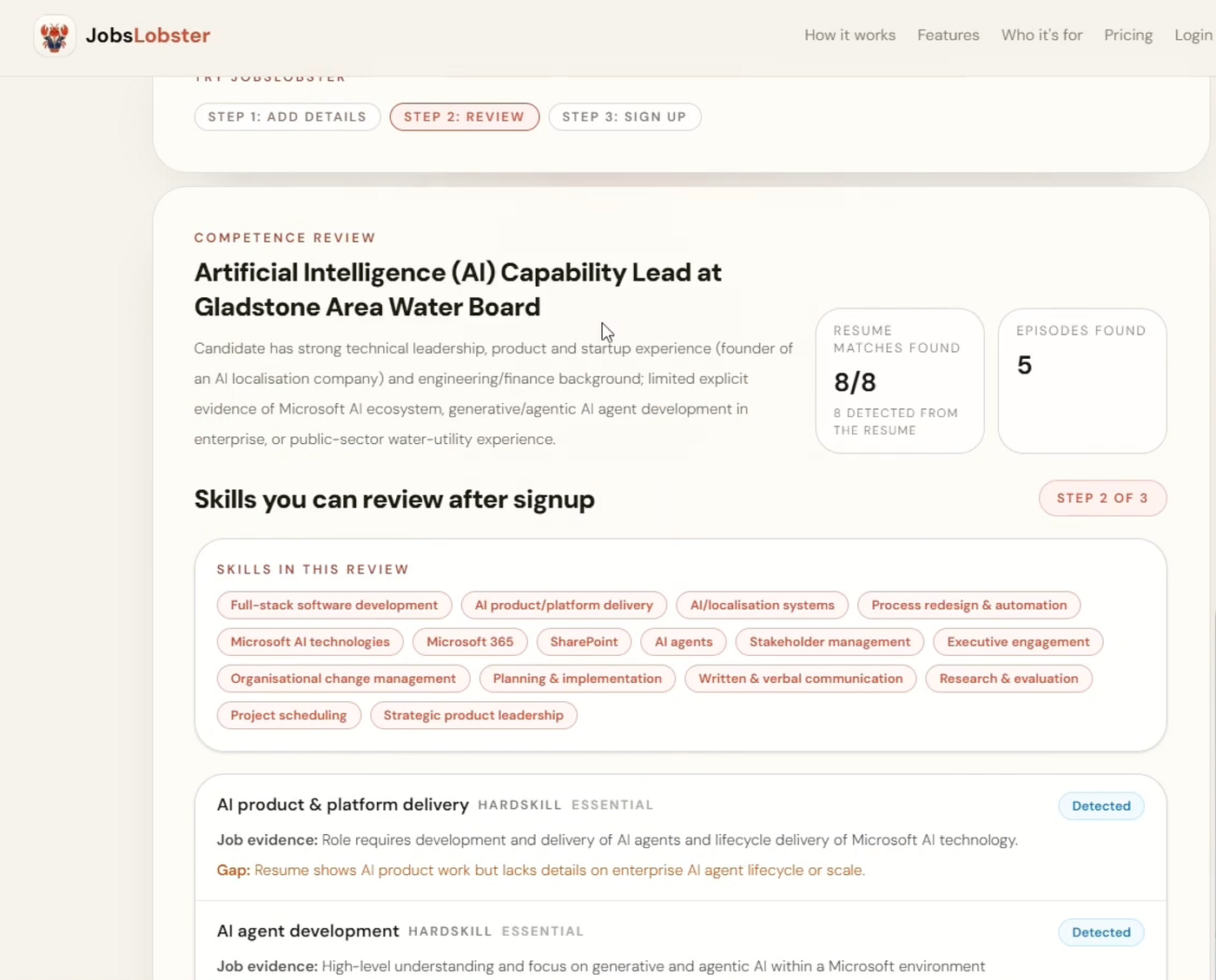
The capability map compares what’s in your resume against what the job description is actually asking for. It doesn’t just flag keywords. It surfaces the specific gaps between how you’re currently presenting yourself and what this particular employer needs.
In practice, it looks like this: “Candidate shows AI product experience, but lacks detail on enterprise AI agentic lifecycle or Microsoft-stack delivery.” That’s a precise, actionable insight. Not generic feedback. Not a vague nudge to “add more detail.” A specific gap you can actually do something about.
Here’s what makes that useful. Say you’re applying for a role that asks for water utilities experience and you don’t have any. But you do have public sector experience. The capability map will flag the gap and prompt you to fill it in by talking to the AI agent about what you do have that’s relevant. The agent remembers. And next time you generate your resume, it has a much richer dataset to draw from.
You’re not inventing experience. You’re surfacing the real experience that simply never made it onto your two-page snapshot.
Everything the tool produces
Once you’ve worked through the capability review, the outputs come together cleanly.
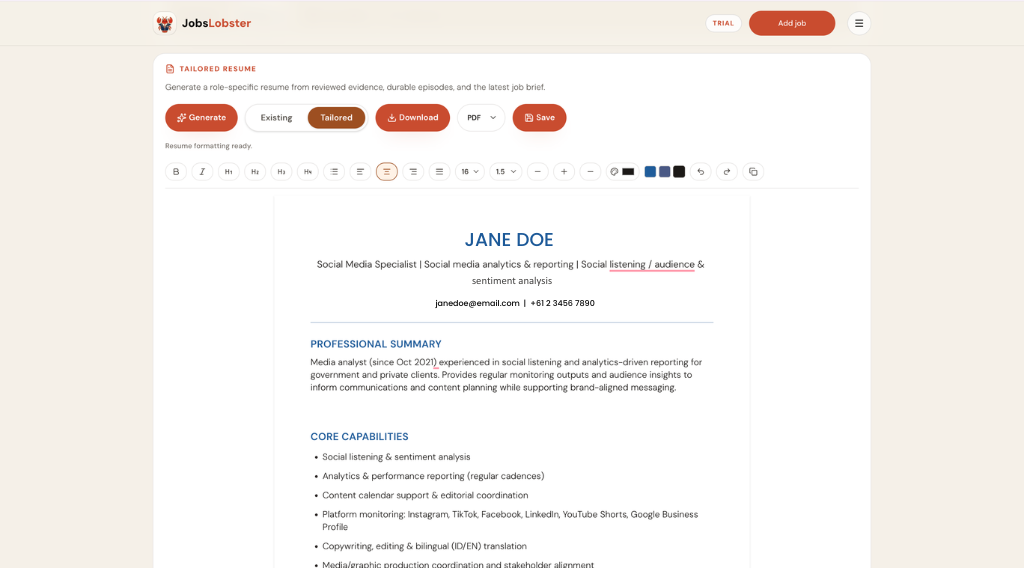
A tailored resume built from your full career picture, not just the version you uploaded
A cover letter shaped to the role
Interview prep with hints specific to the job description
A mock interview capability to practise before the real thing
Everything downloads as a PDF or DOCX, ready to send.
The persistent memory piece is the thread running through all of it. The more conversations you have with the AI agent about your work history, the better every output gets. It’s not a one-click fix. It’s closer to an ongoing conversation with something that’s genuinely trying to understand your professional life.
Why This Matters Beyond Just The Resume
There’s a framing here that doesn’t get said enough.
Employers already have sophisticated AI on their side. They’re using it to scan applications, rank candidates, and filter you out before a human ever reads your name. Getting noticed has become a technical challenge as much as a human one.
Job seekers haven’t had equivalent tools. Most people are still sending the same slightly-updated resume they’ve been using for years, hoping the right words line up with the right role.
That’s not a fair fight.
Persistent career memory matters precisely because it starts to close that gap. It’s not about gaming job applications. It’s about making sure the real depth of your experience, all the stuff that doesn’t fit neatly into two pages, actually gets a chance to show up when it’s relevant.
The capability map reflects this thinking clearly. It doesn’t tell you to overstate your experience. It tells you where you’re underrepresenting yourself. There’s a meaningful difference between those two things.
Where It’s at Right Now
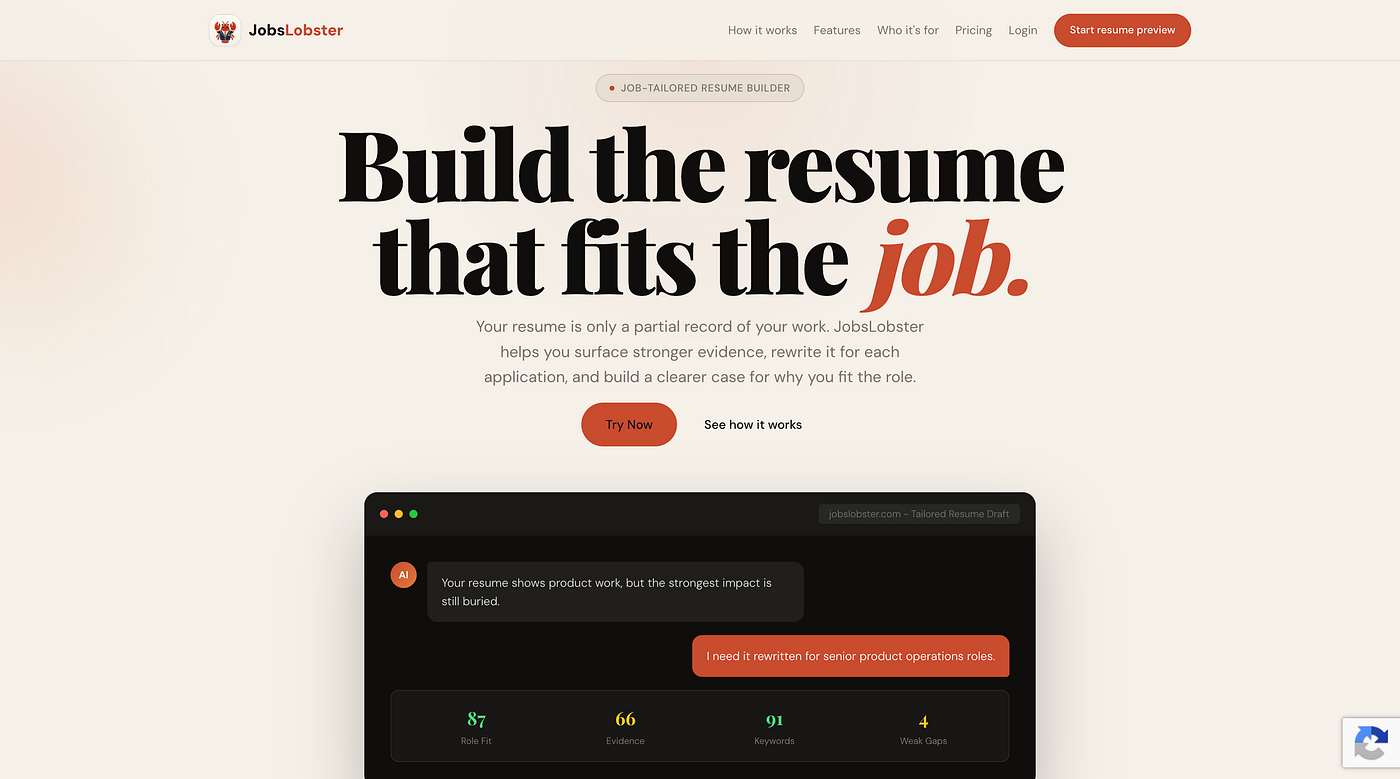
JobsLobster is a work in progress. I’m still chipping away at the features and feel every day. However, our free trial gives you three job applications per week to experiment with, which is a solid way to explore it without any commitment.
If you’re in an active job search, that’s actually enough to feel the difference. Upload a real resume. Grab a real job description from Seek or LinkedIn. Run through the capability map and see what it surfaces. The exercise alone is worth doing, even if you end up writing the resume yourself.
If you need something a bit more robust, paid plans are available, but definitely give the free version a whirl first while we’re still building things out. We’d love to hear what you think in the comments. It seriously helps us make the tool better for you!
The Question Worth Sitting With
Most job search advice treats the resume as a static document. Update it, polish it, tailor it. That advice hasn’t changed much in twenty years.
But careers aren’t static. They’re full of context, nuance, and accumulated experience that a two-page document fundamentally cannot hold. The gap between what you’ve actually done and what fits onto a resume has only grown over time.
Tools that treat your career as a living, expanding picture rather than a fixed snapshot are pointing in a genuinely useful direction. Not because AI is magic, but because the problem of representing yourself accurately to employers is real, and the tools most people use aren’t solving it.
If you’re in a job search right now, or you sense one might be coming, it’s worth asking: what does your professional memory actually look like? Not just the resume you have open in a tab somewhere. The full picture of what you’ve built, what you know, and what you can do.
Getting that down somewhere, even imperfectly, is more valuable than another round of polishing the same two pages.
JobsLobster is one emerging answer to that question. It won’t be the last. But the question being asked is the right one.
What would your application look like if the AI helping you actually knew you?
Live demo: How to stop rewriting your resume for every job application
JobsLobster is available to try at jobslobster.com. Help us improve by leaving your feedback!